
View
Multi-Asset


Capital is at risk. The value and income from investments can go down as well as up and are not guaranteed. An investor may get back significantly less than they invest. Past performance is not a reliable indicator of current or future performance and should not be the sole factor considered when selecting funds.
By selecting intermediary or institutional investor I confirm that I am a financial professional and understand that the information should not be distributed to or relied upon by any other persons. It’s provided for general information purposes only and is not personal advice to anyone to invest in any fund or product. Information taken from trade and other sources is believed to be reliable, although we don’t represent this as accurate or complete and it shouldn’t be relied upon as such.


If you’ve ever had two kids arguing at home, you’ll know the drill.
One says one thing. The other says something completely different. And somewhere in the middle sits the truth… but it takes time, patience and a bit of digging to find it.
Right now, markets feel exactly like that.
We have a ceasefire between the US and Iran, albeit a fragile one. And we’ve seen positive pronouncements from the US, with Donald Trump saying: “very quickly, you’ll see oil start flowing”. However, peace talks broke down over the weekend and the US military is due to start blockading Iranian ports in the Strait of Hormuz today.
On the Iranian side, they seem intent on extracting a toll from ships travelling through the strait, through which around 20% of global oil supplies normally pass. In addition, they say Israel’s attacks on Lebanon are a ‘grave violation’ of the ceasefire terms, something strongly disputed by the US and Israel.
So, while we have a ceasefire, we also have angry rhetoric from both sides that seems to threaten it. What markets are trying to do is work out what’s the signal… and what’s just ‘noise’.
This week’s chart shows just how powerful that noise has been during the conflict – up to the announcement of the ceasefire last week. It tracks how the oil price reacted to a succession of public statements from Trump – some about bringing the war to an end, others more aggressive.
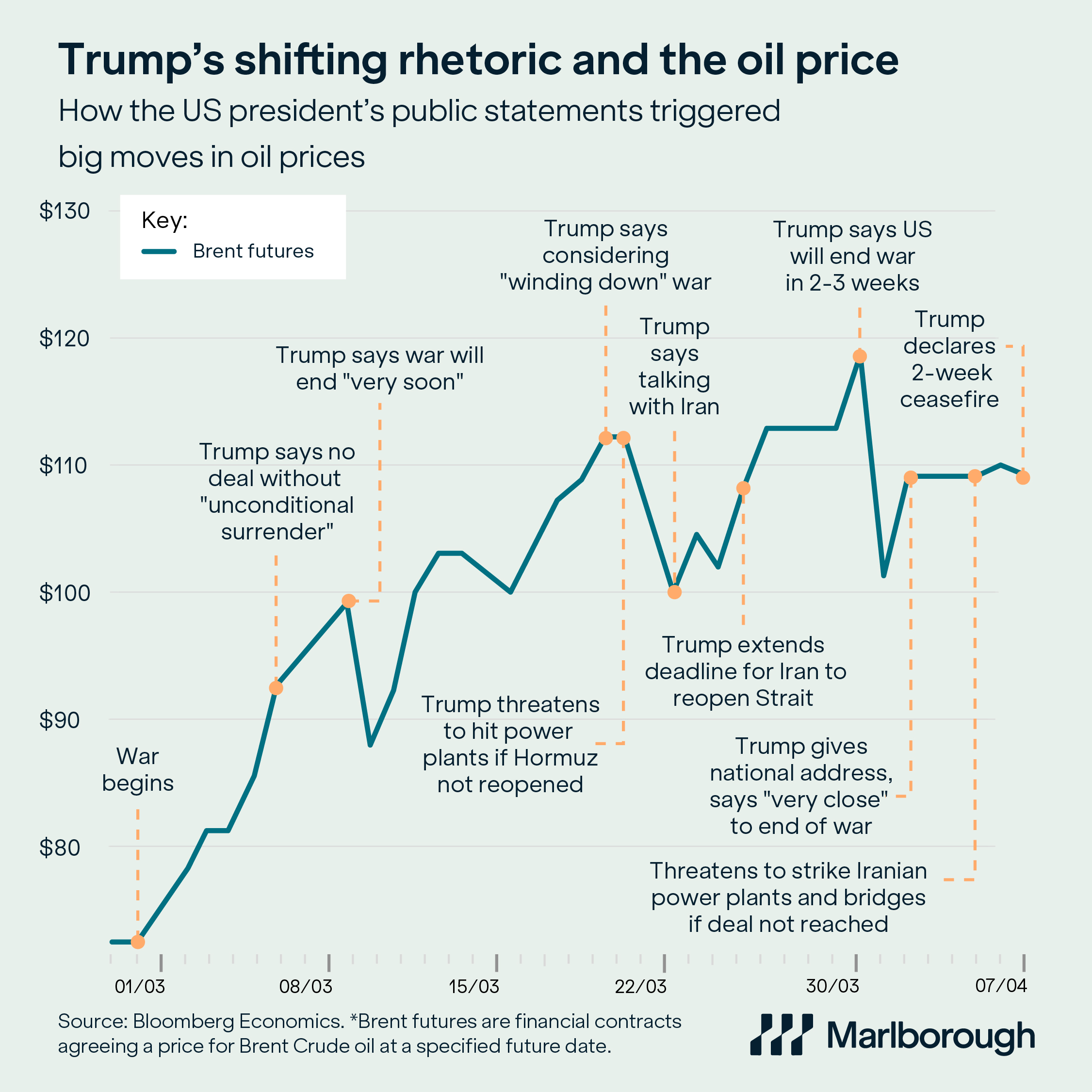
Each major shift in rhetoric – from threats to escalate through to optimism about a ceasefire – has driven sharp moves in oil prices. This tells us that, in the short term, markets aren’t trading fundamentals, they’re trading narratives.
A few key points stand out:
• We’ve moved from escalation to de-escalation. A ceasefire, even a temporary, fragile one, is a clear shift in direction.
• Markets react faster than reality changes. The oil price didn’t wait for large numbers of tankers to start sailing through the Strait of Hormuz again. It moved on headlines alone, like when Trump declared the war would end in two to three weeks.
• Political messaging matters more than ever. We’ve seen that rhetoric, particularly from the US, can drive markets just as much as actual events.
What should investors watch for next? If the past few weeks were about headlines, the days and weeks ahead are likely to be about evidence.
• Shipping through the Strait of Hormuz. Are shipping flows genuinely picking up or still constrained? This is the single biggest real-world indicator for the oil price.
• Ceasefire stability. Do we see a calmer mood taking hold… or breaches that escalate? It won’t take much to shift investor sentiment.
• The tone from the White House and Iran. Does the more peaceful tone from the US administration continue, or does the language harden? Markets are clearly listening.
• Military positioning. Any pause or reversal in troop build-ups will reinforce the belief that the conflict is de-escalating. The opposite will raise questions.
While we’ve seen energy prices begin to rise again today, the initial reaction to the ceasefire was clear: oil pulled back sharply, bond yields* stabilised and interest rate hike expectations eased.
We believe the US is looking for an off-ramp, not further escalation. If that continues, the oil supply should gradually improve, and the need for aggressive rate hikes is unlikely to materialise.
This is one reason why we see an opportunity in government bonds. Investors have sold them, because inflation caused by rising energy costs would make bonds less attractive. But we believe the sell-off went too far, becoming divorced from reality.
The relief rally in stock markets since the ceasefire suggests investors believe a worst-case scenario has become less likely. We’ve moved from conflict to conversation. From escalation to a potential off-ramp.
Just like when kids argue, the worst thing investors can do in a complex situation like this is react to the first thing they hear. Stepping back and focusing on what’s actually changing, not just what’s being said, is where the value lies.
*Yield is the income paid by bonds and other investments. It is usually stated as a percentage of the value of the investment.
This article is provided for general information purposes only and should not be construed as personal financial advice to invest in any fund or product. These are the investment manager’s views at the time of writing and should not be construed as investment advice. The opinions expressed are correct at time of writing and may be subject to change. Capital is at risk. The value and income from investments can go down as well as up and are not guaranteed. An investor may get back significantly less than they invest. Past performance is not a reliable indicator of current or future performance and should not be the sole factor considered when selecting funds.

