
View
Multi-Asset


Capital is at risk. The value and income from investments can go down as well as up and are not guaranteed. An investor may get back significantly less than they invest. Past performance is not a reliable indicator of current or future performance and should not be the sole factor considered when selecting funds.
By selecting intermediary or institutional investor I confirm that I am a financial professional and understand that the information should not be distributed to or relied upon by any other persons. It’s provided for general information purposes only and is not personal advice to anyone to invest in any fund or product. Information taken from trade and other sources is believed to be reliable, although we don’t represent this as accurate or complete and it shouldn’t be relied upon as such.


As an investment team, we’ve been closely monitoring developments in the Middle East since the joint US and Israeli military strikes on Iran began at the weekend. With any significant geopolitical event like this, we work tirelessly to assess the implications for our portfolios.
What was perhaps more surprising than the strikes on Iran, was the scale of Tehran’s retaliatory strikes, which extended across the Gulf and even as far west as Cyprus. This led to widespread disruption in the region, with airlines cancelling flights and with shipping through the Strait of Hormuz, which lies south of Iran, effectively suspended.
As we continue to analyse the investment implications of the renewed conflict, one of the key data points we’re closely monitoring is the oil price.
While Middle East geopolitics often have a limited direct impact on stock markets that tends to change if one thing happens: the oil price spikes and stays elevated.
Oil jumped as markets reopened after the strikes. Brent Crude briefly traded above around $82 per barrel but then eased back to the high $70s. The immediate focus has been the risk of disruption to oil and gas flows through the Strait of Hormuz, which is a chokepoint for global shipping.
As the chart below shows, oil price spikes can push up inflation, because they act like a tax on the global economy. Energy costs go up, transport and production costs rise, and consumers have less to spend elsewhere. And, as inflation picks up, central banks often hesitate to cut interest rates – a potent combination that can act as a drag on economic growth.
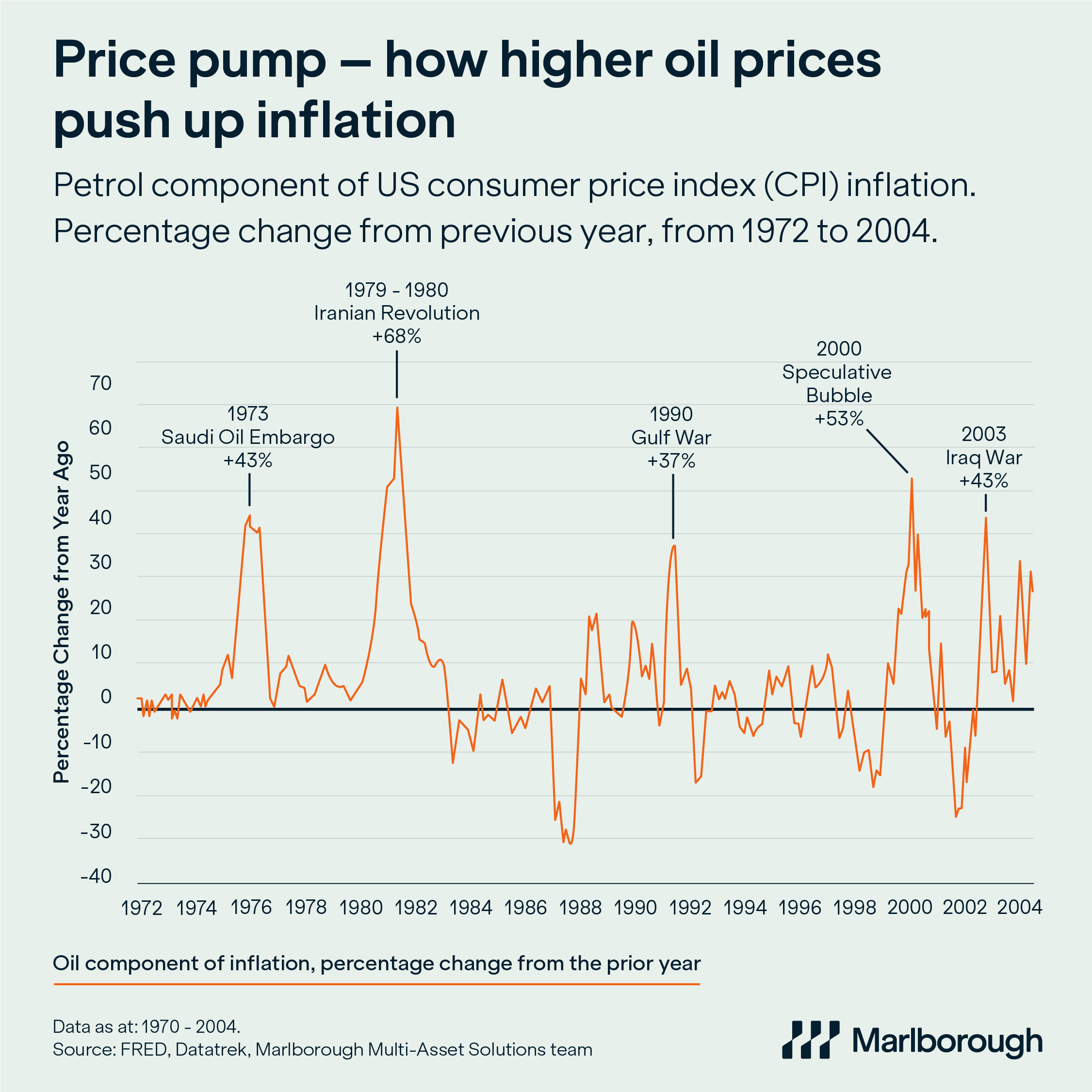
The important takeaway is that it’s not any rise in the oil price that matters. It’s the size and persistence of the move that’s key for stock markets.
Coming into 2026, oil was roughly around $60 per barrel on average. Using that as a baseline, we would typically need to see something closer to a doubling of the price, and crucially, for it to be sustained, before it’s likely to become a meaningful macroeconomic problem. By this we mean creating a persistent rise in inflation, triggering a consumer squeeze and a pullback in discretionary spending that risks pushing the global economy into recession.
That’s why the key threshold remains a sustained move above the $100 per barrel level. We are not there today. Even after the post-strikes spike, prices remain well below that level.
We think a sustained spike is less likely, although not impossible. If prices were to run materially higher and stay there, the key swing factor would be whether disruption becomes prolonged. That could be, for example, through sustained constraints to shipping and exports – rather than a short, sharp shock.
There are also potential mitigating factors on the supply side. The oil-producing nations’ organisation, OPEC+, has signalled an increase in supplies from April, which could help to cushion the market if prices stay elevated. Major consuming nations can also draw on strategic oil stockpiles if needed (a tool that can smooth short-term price spikes, even if it doesn’t solve longer-term supply issues).
Not every stock market is likely to react in the same way. The UK market, for example, has relatively high exposure to energy companies, which can benefit when oil rises. This can provide some balance when other areas of the market come under pressure. History also shows markets can rebound quickly on the first credible sign of de-escalation. And, more often than not, the oil price gives that signal before the headlines do.
As a team, we are studying this fast-moving situation very closely. This includes monitoring the oil price to see if the movement becomes large and sustained, particularly above around $100 per barrel. For now, oil has risen, but it remains below the ‘danger zone’. However, rest assured that as events continue to unfold, we will remain sharply focused on latest developments and their implications for our investors. If there are significant new developments then we will, of course, provide a fresh update.
It’s also worth mentioning that one of the benefits of multi-asset investing is that it provides diversification designed to help manage risk and smooth returns during periods of geopolitical uncertainty.
This article is provided for general information purposes only and should not be construed as personal financial advice to invest in any fund or product. These are the investment manager’s views at the time of writing and should not be construed as investment advice. The opinions expressed are correct at time of writing and may be subject to change. Capital is at risk. The value and income from investments can go down as well as up and are not guaranteed. An investor may get back significantly less than they invest. Past performance is not a reliable indicator of current or future performance and should not be the sole factor considered when selecting funds.

