
View
Multi-Asset


Capital is at risk. The value and income from investments can go down as well as up and are not guaranteed. An investor may get back significantly less than they invest. Past performance is not a reliable indicator of current or future performance and should not be the sole factor considered when selecting funds.
By selecting intermediary or institutional investor I confirm that I am a financial professional and understand that the information should not be distributed to or relied upon by any other persons. It’s provided for general information purposes only and is not personal advice to anyone to invest in any fund or product. Information taken from trade and other sources is believed to be reliable, although we don’t represent this as accurate or complete and it shouldn’t be relied upon as such.


September marks the return to school and, for many families, the return of logistical chaos.
There are uniforms to find, bags to pack and an ever-changing schedule of clubs and after-school activities. After the relative freedom of summer, the adjustment can feel painful. But it’s simply a return to normal routine. And something similar may be happening in bond markets.
After several years of rising yields*, volatile prices and gloomy headlines, investors could be forgiven for questioning whether bonds can still play their traditional role in a portfolio.
However, the recent bond market turbulence doesn’t mean that bonds are broken. It may instead show bond markets are finally returning to something more normal.
For much of the period following the global financial crisis, interest rates were close to zero and central banks bought enormous quantities of government debt through a process known as ‘quantitative easing’.
These factors helped push bond yields to unusually low levels. During the pandemic, the yield on 10-year US government bonds** (also known as Treasuries) briefly fell to around 0.5%.
Investors became accustomed to this world, but historically it was the exception rather than the rule.
When inflation returned and central banks raised interest rates, bonds suffered because yields and prices move in opposite directions. Rising yields therefore produced falling prices, culminating in an especially difficult period for bond investors in 2022.
But there’s another side to this equation: higher yields can also benefit investors. The higher the yield available when a bond is purchased, the more income the investor receives. This income can provide a cushion against further price falls and can be reinvested at the new, higher yields.
This helps explain why bond returns can remain positive even while yields are rising.
Over the past year, the broad US Treasury market (as measured by the Bloomberg Total Return US Treasury Index) delivered a positive total return*** despite the 10-year Treasury yield rising by approximately 0.6 percentage points, which meant the price fell.
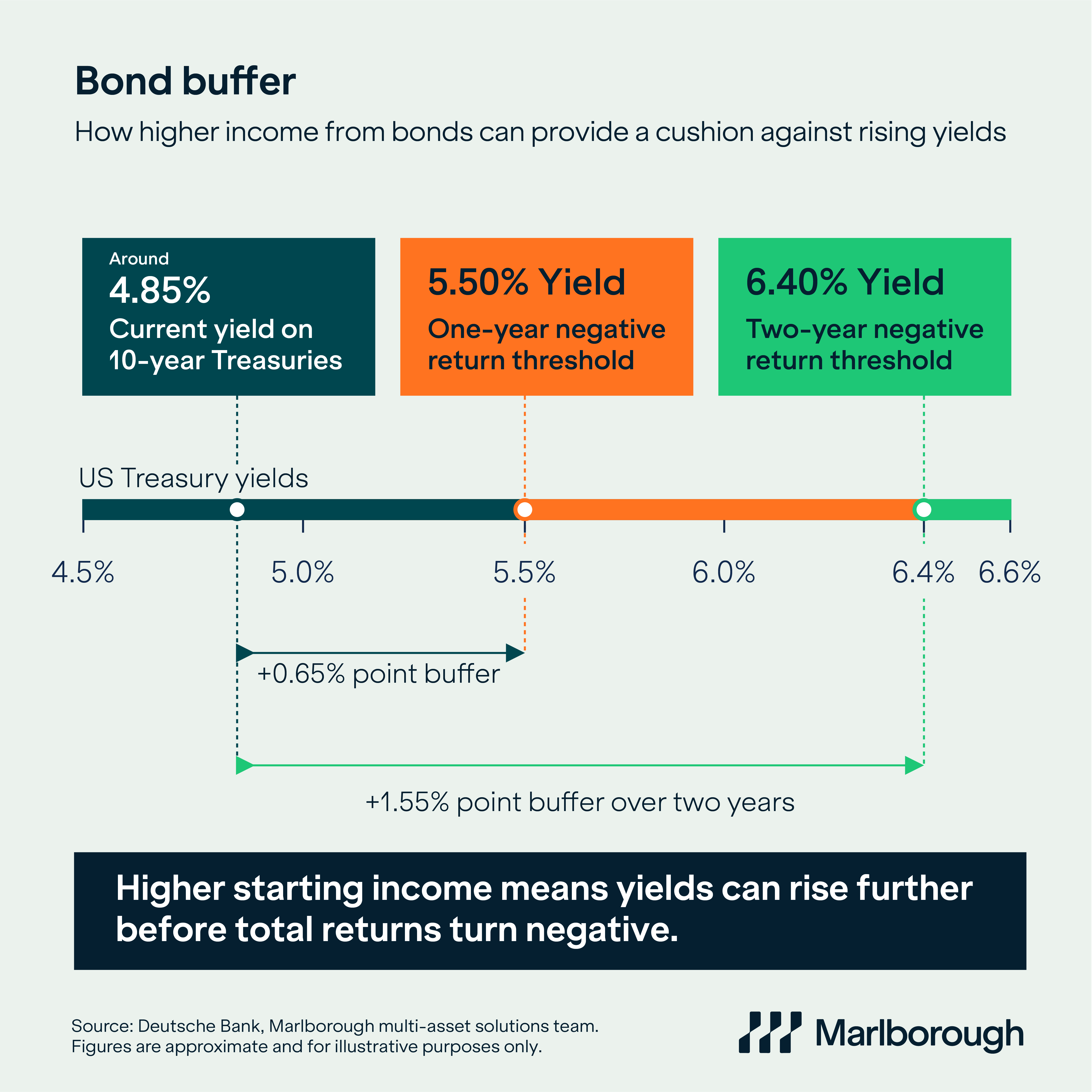
This principle is illustrated in this week’s chart, which shows how the income from bonds can provide a buffer before rising yields result in a negative overall return. Deutsche Bank calculations show the yield on a 10-year Treasury, which is currently around 4.85%, would need to rise to roughly 5.5% over one year, or 6.4% over two years, before the starting income was overwhelmed and total returns turned negative.
Bond markets may continue to struggle with heavy government borrowing, an uncertain inflation outlook and concerns over public finances.
But the proposition has changed. When yields were near zero, bonds offered little income and very limited protection against rising interest rates. At today’s higher yields, bonds can once again provide meaningful income, have the potential to create a cushion against price volatility and can offer diversification when economic growth weakens.
After years during which they often failed to provide the characteristics investors expected, bonds are beginning to behave like bonds again.
*Yield is the income paid by bonds or other investments. It’s usually stated as a percentage of the value of the investment. When bond yields rise, this means bond prices fall.
**The US government is due to repay the money borrowed through a 10-year Treasury 10 years after it’s issued.
***Total return is the price change plus any income.
This article is provided for general information purposes only and should not be construed as personal financial advice to invest in any fund or product. These are the investment manager’s views at the time of writing and should not be construed as investment advice. The opinions expressed are correct at time of writing and may be subject to change. Capital is at risk. The value and income from investments can go down as well as up and are not guaranteed. An investor may get back significantly less than they invest. Past performance is not a reliable indicator of current or future performance and should not be the sole factor considered when selecting funds.

