
View
Multi-Asset


Capital is at risk. The value and income from investments can go down as well as up and are not guaranteed. An investor may get back significantly less than they invest. Past performance is not a reliable indicator of current or future performance and should not be the sole factor considered when selecting funds.
By selecting intermediary or institutional investor I confirm that I am a financial professional and understand that the information should not be distributed to or relied upon by any other persons. It’s provided for general information purposes only and is not personal advice to anyone to invest in any fund or product. Information taken from trade and other sources is believed to be reliable, although we don’t represent this as accurate or complete and it shouldn’t be relied upon as such.


One of my five-a-side football teammates picked me up a few days ago in his new Polestar electric car. Naturally, my first question was, “How does it compare to the Tesla?”
He ran through all the pros of the Polestar, which is made by a company part-owned by Volvo, before ending with, “I still prefer the Tesla.”
That got me thinking, and it tied neatly to a question a client asked earlier this week:
“Which of the big seven US tech stocks are you most worried about?”
When you look at the tech giants, Tesla often stands out as one of the most expensive shares. In simple terms, people are paying a lot today for what they expect Tesla to earn in the future.
So why are investors happy to do that? Because many don’t see Tesla as just a car company. They see it as a technology company. It makes cars, yes, but it’s also building batteries, robots and software that could power the next generation of automation.
One of its biggest focuses is self-driving vehicle technology, and that’s where the data really turns heads.
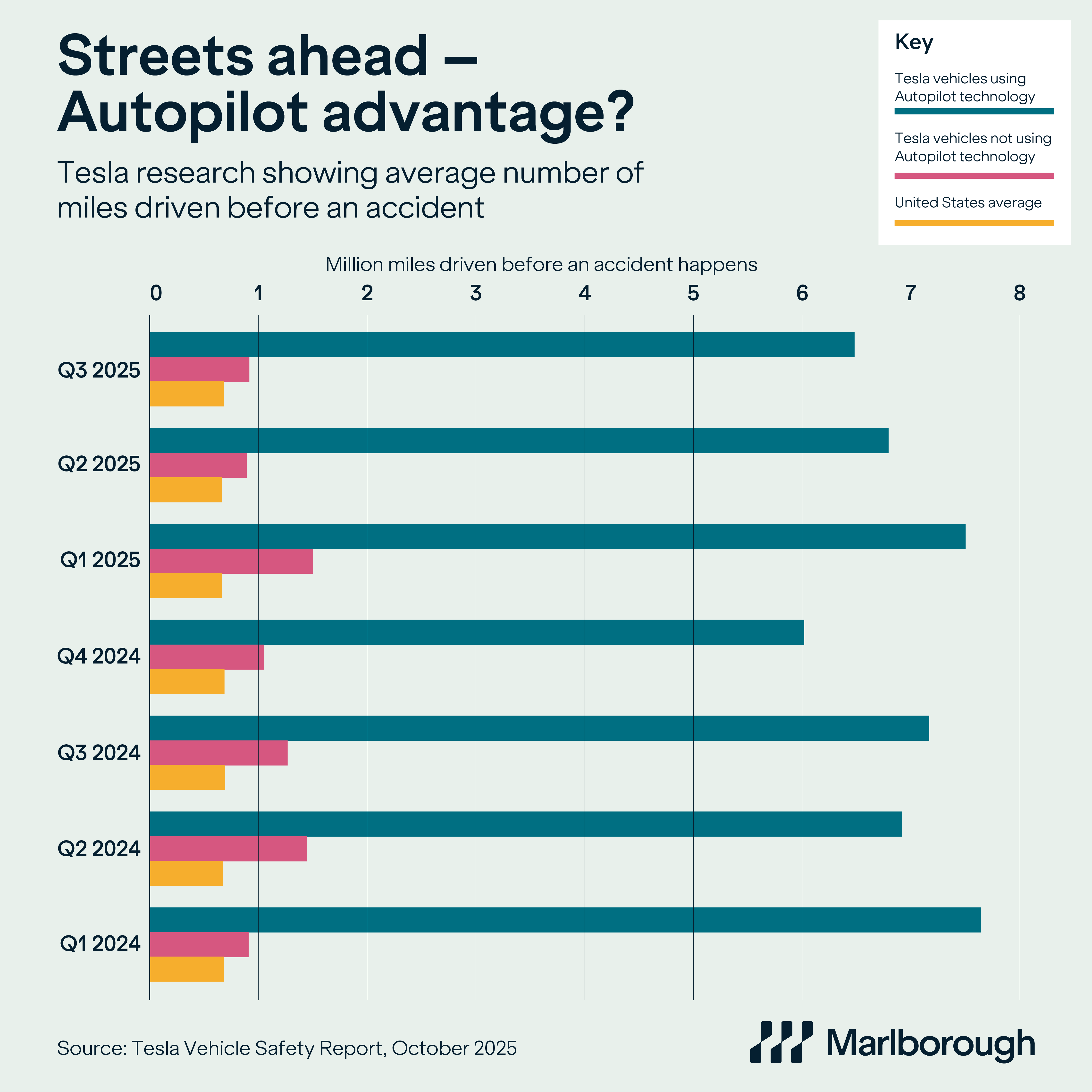
This week’s chart, based on Tesla’s latest Vehicle Safety Report, shows how many miles are driven on average before an accident happens. It compares Tesla vehicles using the company’s Autopilot technology with Teslas not using it and the US average.
While Autopilot does not provide a fully autonomous (unsupervised) driving capability, it uses cameras and sensors to help with steering, braking and acceleration and the enhanced package can include self-parking.
Tesla’s data shows vehicles using Autopilot can go over six million miles on average before an accident, which is around nine times safer than the US average.
That’s a huge safety advantage, so it’s easy to see why people are getting excited about what this means for the future of driving.
I also read this week that Uber plans to launch driverless taxis in San Francisco next year, joining Tesla in the autonomous vehicles race. But Uber faces one big challenge. Under its current model, it doesn’t own its cars. To make driverless cabs work at scale, it would need to spend billions upfront buying vehicles.
Now imagine if your Tesla, which probably spends most of its time parked on the driveway, could one day earn you extra income by driving itself for Uber while you’re at work.
That’s the kind of future investors are picturing.
Tesla might look expensive, but people aren’t just paying for the cars it sells today. They’re paying for Tesla’s potential to help reshape how we travel, work and think about transport itself. Innovation comes with a price tag, and it’s Tesla’s transformative potential that keeps investors interested.
This article is provided for general information purposes only and should not be construed as personal financial advice to invest in any fund or product. These are the investment manager’s views at the time of writing and should not be construed as investment advice. The opinions expressed are correct at time of writing and may be subject to change. Capital is at risk. The value and income from investments can go down as well as up and are not guaranteed. An investor may get back significantly less than they invest. Past performance is not a reliable indicator of current or future performance and should not be the sole factor considered when selecting funds.

