
View
Multi-Asset


Capital is at risk. The value and income from investments can go down as well as up and are not guaranteed. An investor may get back significantly less than they invest. Past performance is not a reliable indicator of current or future performance and should not be the sole factor considered when selecting funds.
By selecting intermediary or institutional investor I confirm that I am a financial professional and understand that the information should not be distributed to or relied upon by any other persons. It’s provided for general information purposes only and is not personal advice to anyone to invest in any fund or product. Information taken from trade and other sources is believed to be reliable, although we don’t represent this as accurate or complete and it shouldn’t be relied upon as such.


The US midterm elections tomorrow will decide who controls the House of Representatives and the Senate. The results could have major implications for President Donald Trump’s remaining time in the White House.
Yet behind the political drama lies a much more immediate concern for voters: the everyday cost of living. Inflation affects how much people pay for food, fuel, housing and healthcare.
It remains one of the economic issues people experience most directly. Interest rates, government borrowing and economic growth can feel abstract. The cost of filling up the car or paying for the weekly shop doesn’t.
That’s why the cost of living is a key issue in the midterms, which will be an important test for the Trump administration. If the Democrats take control of one or both chambers of Congress, they may be able to frustrate new legislation and, depending on the result, constrain spending or presidential appointments.
One of the most common misunderstandings about inflation is that a lower inflation rate means prices are falling. Usually, it doesn’t. It means prices are still rising, but at a slower rate.
This distinction matters because the steep price increases experienced since the pandemic have not been reversed. Instead, they have become embedded in the cost of goods and services.
Inflation also has important implications for savers. Cash plays an essential role in covering short-term expenses and providing an emergency reserve. But over longer periods, holding too much in cash introduces a quieter risk: a gradual erosion of spending power.
Our chart shows how the surge of inflation after the Covid crisis has reduced the value of sterling, the US dollar and the euro in real terms. Prices rose, so every pound, dollar or euro bought less of whatever you were paying for. In other words, the ‘purchasing power’ of these currencies was eroded.
Between January 2020 and the end of September this year, the purchasing power of £100 fell to £75, $100 fell to $75 and €100 fell to €78. The figures printed on those bank notes haven’t altered. But what those notes can buy has been significantly reduced.
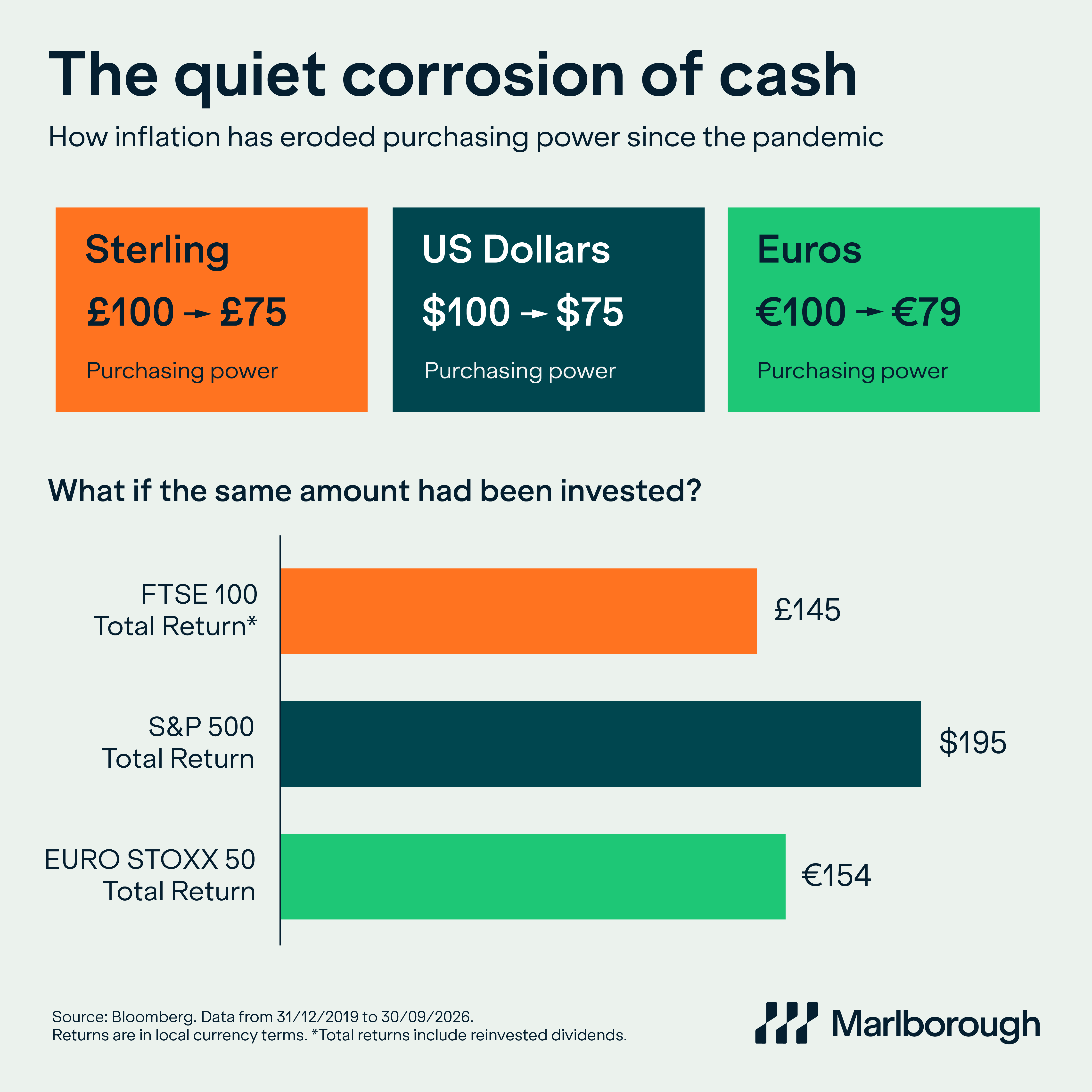
The chart also shows how £100, $100 and €100 would have grown in value if they’d been invested in a fund tracking the FTSE 100, US S&P 500 and Euro Stoxx 50 respectively. Over the same period, investors haven’t just kept pace with inflation, they’ve enjoyed meaningful growth in real terms.
An investor who put money into stock markets at the beginning of 2020 has experienced no shortage of uncertainty. As well as the pandemic, the intervening period has included wars, an inflation shock, rapidly rising interest rates and repeated political disruption.
Despite this, major stock markets have produced positive returns. This doesn’t mean they can protect investors during every period of inflation. Share prices can fall, and stock markets may underperform inflation over shorter periods. It’s also worth noting that our chart focuses purely on purchasing power, rather than looking at cash deposits, which would have earned interest. However, the comparison illustrates an important principle.
Cash preserves its face value, but inflation can erode its spending power. Company shares offer investors an opportunity to participate in economic growth and the potential to benefit from corporate profits and dividends. Over time, this can help compensate for the corrosive effect of rising prices.
Inflation doesn’t need to remain unusually high to cause lasting damage to your wealth. Even moderate inflation compounds over time. Markets will always face political and economic uncertainty. But a suitably diversified portfolio has the potential to grow alongside the economy.
This article is provided for general information purposes only and should not be construed as personal financial advice to invest in any fund or product. These are the investment manager’s views at the time of writing and should not be construed as investment advice. The opinions expressed are correct at time of writing and may be subject to change. Capital is at risk. The value and income from investments can go down as well as up and are not guaranteed. An investor may get back significantly less than they invest. Past performance is not a reliable indicator of current or future performance and should not be the sole factor considered when selecting funds.

