
View
Multi-Asset


Capital is at risk. The value and income from investments can go down as well as up and are not guaranteed. An investor may get back significantly less than they invest. Past performance is not a reliable indicator of current or future performance and should not be the sole factor considered when selecting funds.
By selecting intermediary or institutional investor I confirm that I am a financial professional and understand that the information should not be distributed to or relied upon by any other persons. It’s provided for general information purposes only and is not personal advice to anyone to invest in any fund or product. Information taken from trade and other sources is believed to be reliable, although we don’t represent this as accurate or complete and it shouldn’t be relied upon as such.


Where I live, the garden centre of choice is Squires. And as someone with an allotment (and a mild addiction to “just popping in for compost”), I’ve spent plenty of weekends wandering those aisles.
If you’ve ever walked into a garden centre without a plan, you’ll know the feeling: sensory overload. Hundreds of plants, shrubs, herbs and “this will definitely thrive in your garden” promises. Most of us have bought something that never really worked out, not because we’re hopeless gardeners, but because the only real teacher is time and experience. You learn what thrives in your soil, what sulks, what needs shelter and what simply isn’t built for British weather in March.
Over the last few weekends, I’ve been doing the opposite of impulse buying. I’ve been planting bulbs for next spring, working quietly now for results later.
And in many ways, that’s exactly what we’re doing as an investment team as we prepare for next year.
One of the big themes for 2026 will be the US midterm elections in November, which will fall midway through Donald Trump’s second term in the White House. All 435 seats in the House of Representatives and a third of the seats in the Senate will be up for grabs.
The run-up to the midterms tends to follow a familiar pattern: plenty of speculation, plenty of headlines and plenty of investors trying to trade the stock market on every new opinion poll number. This is often followed by relief when the results are announced, and uncertainty clears. Historically, the US stock market has tended to be choppier ahead of midterm elections, with stronger returns often coming through after the vote (although history never provides any guarantees).
With the midterms looming, Trump’s One Big Beautiful Bill Act (OBBBA), which was signed into law on 4th July, included a series of measures designed to please voters, including tax breaks for families and businesses that will take effect before November’s elections.
Our chart this week highlights a simple point: the growth impact from the OBBBA is expected to be strongest next year. This is based on analysis by the Congressional Budget Office (CBO), a federal agency that provides economic and budget information to Congress. It has looked at the impact the measures in the act are likely to have on the US economy.
The CBO estimates that in 2026 these measures could add around 0.9% to real gross domestic product (GDP) growth – which is how much economic output increases, after inflation has been factored in. The effects would then fade over time, reaching around 0.4% by 2034.
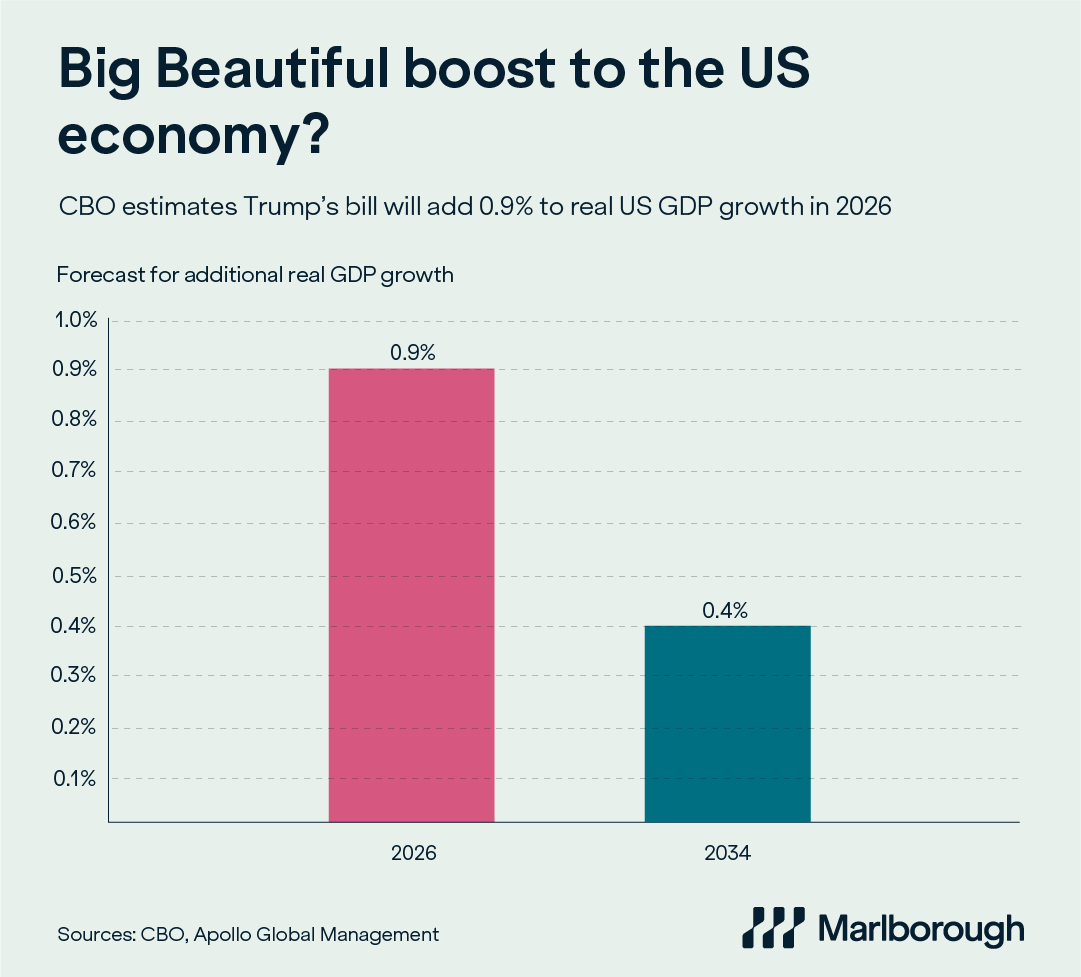
Why the immediate economic boost? The measures in the bill encourage businesses to invest sooner rather than later. Companies will be able to accelerate the process of ‘writing off’ certain spending – such as buying machinery and computer equipment or investing in research – to reduce their tax bill. This kind of incentive is expected to encourage companies to bring forward their investment plans and give the US economy an extra push next year.
As an investment team, we’ll be closely watching events in the US, and, as always, making sure our portfolios are positioned appropriately.
Just like with gardening, if you want to save time (and reduce the cost of trial and error), it’s worth speaking to an expert, who can help make the difference between planting whatever looks good on the day and nurturing what’s most likely to grow over time.
This article is provided for general information purposes only and should not be construed as personal financial advice to invest in any fund or product. These are the investment manager’s views at the time of writing and should not be construed as investment advice. The opinions expressed are correct at time of writing and may be subject to change. Capital is at risk. The value and income from investments can go down as well as up and are not guaranteed. An investor may get back significantly less than they invest. Past performance is not a reliable indicator of current or future performance and should not be the sole factor considered when selecting funds.

