
View
Multi-Asset


Capital is at risk. The value and income from investments can go down as well as up and are not guaranteed. An investor may get back significantly less than they invest. Past performance is not a reliable indicator of current or future performance and should not be the sole factor considered when selecting funds.
By selecting intermediary or institutional investor I confirm that I am a financial professional and understand that the information should not be distributed to or relied upon by any other persons. It’s provided for general information purposes only and is not personal advice to anyone to invest in any fund or product. Information taken from trade and other sources is believed to be reliable, although we don’t represent this as accurate or complete and it shouldn’t be relied upon as such.


On a recent trip to Marrakech, one thing gripped my attention even more than the heat: the art of selling a story.
A day trip into the Atlas Mountains came with all the usual stops. Pottery shops. Jewellery stalls. An “authentic” Berber house. And, of course, the argan oil shop, where argan oil was presented as the elixir of life. Good for your skin, your hair, your cooking, and, if the sales pitch was to be believed, almost every ailment under the sun.
The difficulty in those moments is knowing whether you’re looking at something genuinely valuable or simply being swept up in a compelling narrative.
Which brings us neatly to SpaceX.
This week investors are likely to hear a lot about what is expected to be the world’s largest stock market flotation – or, to use the industry terminology, Initial Public Offering (IPO). Unsurprisingly, we’ve already started receiving questions about whether clients will gain exposure through their portfolios and whether SpaceX represents the next great investment opportunity.
As a company, SpaceX is undoubtedly remarkable, and it comprises three distinct business segments.
Starlink, the profit engine, has more than 10,000 satellites beaming high-speed internet to over 10m subscribers in 160 countries. Meanwhile, SpaceX’s reusable rocket technology has fundamentally altered the economics of space travel and created a competitive advantage that rivals have yet to match. And now, the company has plans for huge expansion focusing on artificial intelligence, data centres in space and long-term space exploration. The company has already absorbed Elon Musk’s xAI business, which includes the Grok AI model. Combine all this and it’s easy to see why investors are excited.
The challenge is that excitement and valuation are not the same thing.
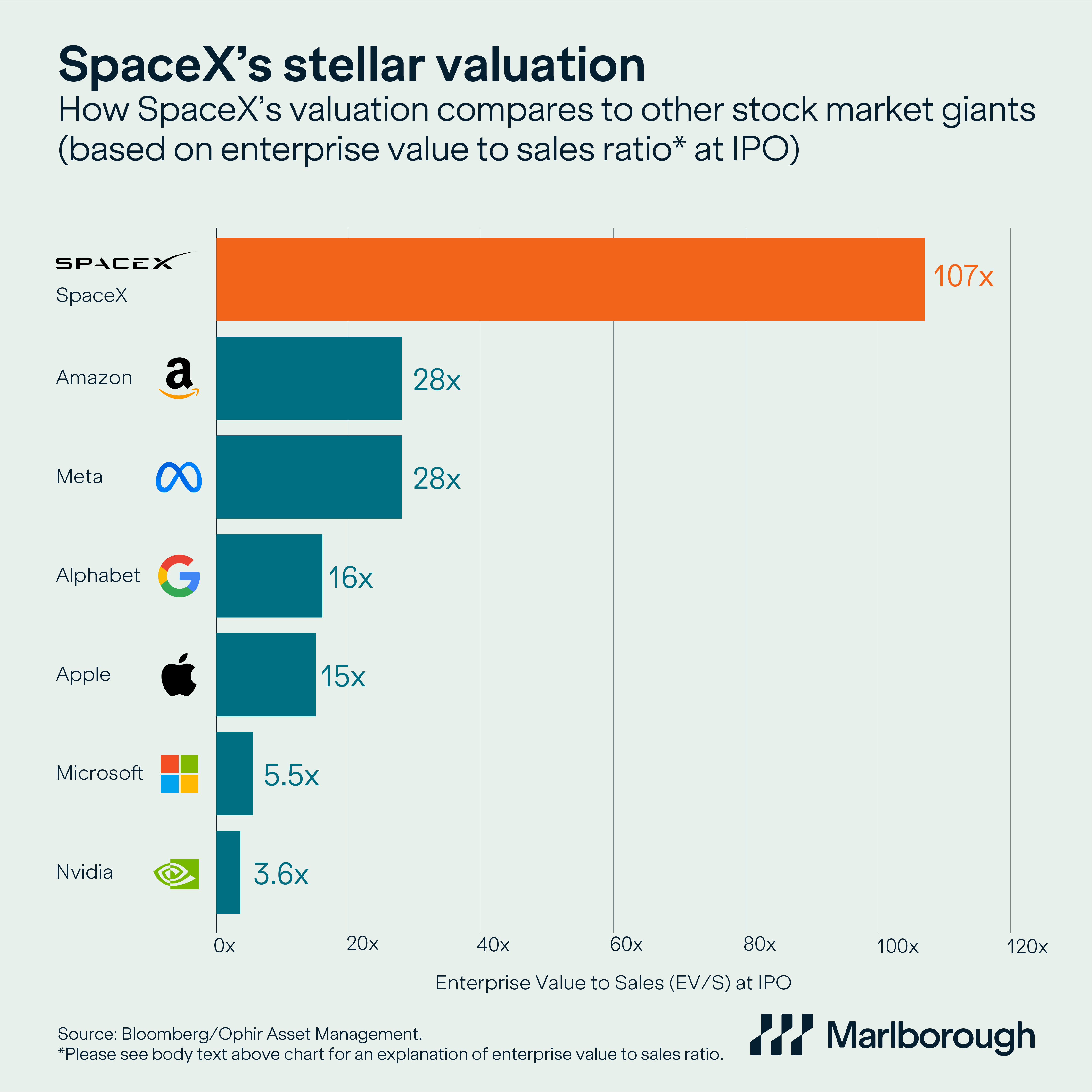
SpaceX is reported to be seeking an IPO valuation of around $1.75 trillion. It’s interesting to see how that compares with listings by other major companies. Professional investors often assess whether a company looks overvalued or undervalued by calculating its ‘enterprise value to sales’ ratio. Essentially, this compares what it would cost to buy a business against its sales for the most recent year.
The first step is to calculate the enterprise value. This is the market capitalisation, which is the total stock market value (the number of shares issued multiplied by the share price) plus any debt. Any cash held by the company is then subtracted from the figure. The enterprise value is then divided by the value of the latest year’s sales.
On this measure, as our chart shows, the SpaceX valuation is stratospheric when compared to those of stock market giants like Amazon, Meta, Apple and Nvidia when they listed.
Of course, when discussing SpaceX, it’s impossible to ignore Elon Musk.
Whether you admire him or not, his track record of commercialising technologies that once seemed impossible is extraordinary. From electric vehicles to reusable rockets, he has consistently delivered outcomes that many thought were unattainable. Unsurprisingly, investors are willing to pay a premium for this track record.
The question is just how much of a premium is it reasonable to pay for SpaceX, even with Musk at the helm?
For investors in our diversified multi-asset portfolios, however, there’s another question: will I own it?
At this stage, the answer is likely to be only a very small amount or not at all. That’s because initial exposure across our portfolios is likely to be zero or negligible.
Given the valuation, we don’t expect any of the active funds, where a manager ‘actively’ picks the stocks, that we hold to have any meaningful exposure. We’re also expecting very limited exposure in the ‘passive’ funds we hold, which buy all the companies in a specified stock market index.
That’s because only around 4% of SpaceX shares, worth around $75 billion, are expected to be available to public investors initially. And it’s this amount – the free float – that index providers use to calculate a company’s value, and thus its size in the index.
As a result, despite the enormous headline valuation, SpaceX’s initial weight within major indices is likely to be surprisingly modest.
Stock market rules mean SpaceX is unlikely to be added to the S&P 500 index until 2027, but it’s expected to find a place more quickly in the tech-heavy Nasdaq 100. However, one estimate suggests SpaceX will initially represent only around 0.4% of the Nasdaq 100 index.
A trillion-dollar valuation does not automatically translate into a trillion-dollar portfolio position. For most investors, SpaceX will initially be a relatively small part of a diversified portfolio. If it fulfils its huge ambitions and becomes one of the defining companies of the next generation, it’s size in the index will grow and investors' exposure will grow with it. That’s diversification in action – and it strikes us as a sensible approach.
This article is provided for general information purposes only and should not be construed as personal financial advice to invest in any fund or product. These are the investment manager’s views at the time of writing and should not be construed as investment advice. The opinions expressed are correct at time of writing and may be subject to change. Capital is at risk. The value and income from investments can go down as well as up and are not guaranteed. An investor may get back significantly less than they invest. Past performance is not a reliable indicator of current or future performance and should not be the sole factor considered when selecting funds.

