
View
Multi-Asset


Capital is at risk. The value and income from investments can go down as well as up and are not guaranteed. An investor may get back significantly less than they invest. Past performance is not a reliable indicator of current or future performance and should not be the sole factor considered when selecting funds.
By selecting intermediary or institutional investor I confirm that I am a financial professional and understand that the information should not be distributed to or relied upon by any other persons. It’s provided for general information purposes only and is not personal advice to anyone to invest in any fund or product. Information taken from trade and other sources is believed to be reliable, although we don’t represent this as accurate or complete and it shouldn’t be relied upon as such.


There’s a real buzz in London at the moment. Crowds have been spilling out onto the streets to watch the World Cup and anticipation is now building among England fans ahead of the quarter-final match against Norway on Saturday.
And it’s not just football. Over in SW19, tennis fans have been joining the famous queue in the early hours to try to secure a grounds pass for Wimbledon.
I was lucky enough to watch Novak Djokovic’s opening match against Wu Yibing on TV. With two young children in the house, getting any time to watch TV feels like a luxury. Djokovic is the Marmite of the tennis world. People tend to either love him or love to see him lose. But whatever your view, it’s hard to question his grit, resilience and determination.
The final score was 6-4, 5-7, 6-4, 6-4. On paper, that looks controlled enough. But the scoreline didn’t tell the full story. Wu pushed him hard, Djokovic had to respond to losing the second set and at key moments he had to dig deep to stay in control of the match.
That’s often the way in tennis. You can lose plenty of points and still win the match. Roger Federer once made this point brilliantly when he noted that, across his career, he won almost 80% of his singles matches, despite winning only around 54% of the points he played. In other words, even the very best in the world can lose almost every other point. What matters isn’t perfection, it’s staying focused, winning enough of the important moments and keeping yourself in the match.
Markets have delivered a similar lesson over the first half of this year.
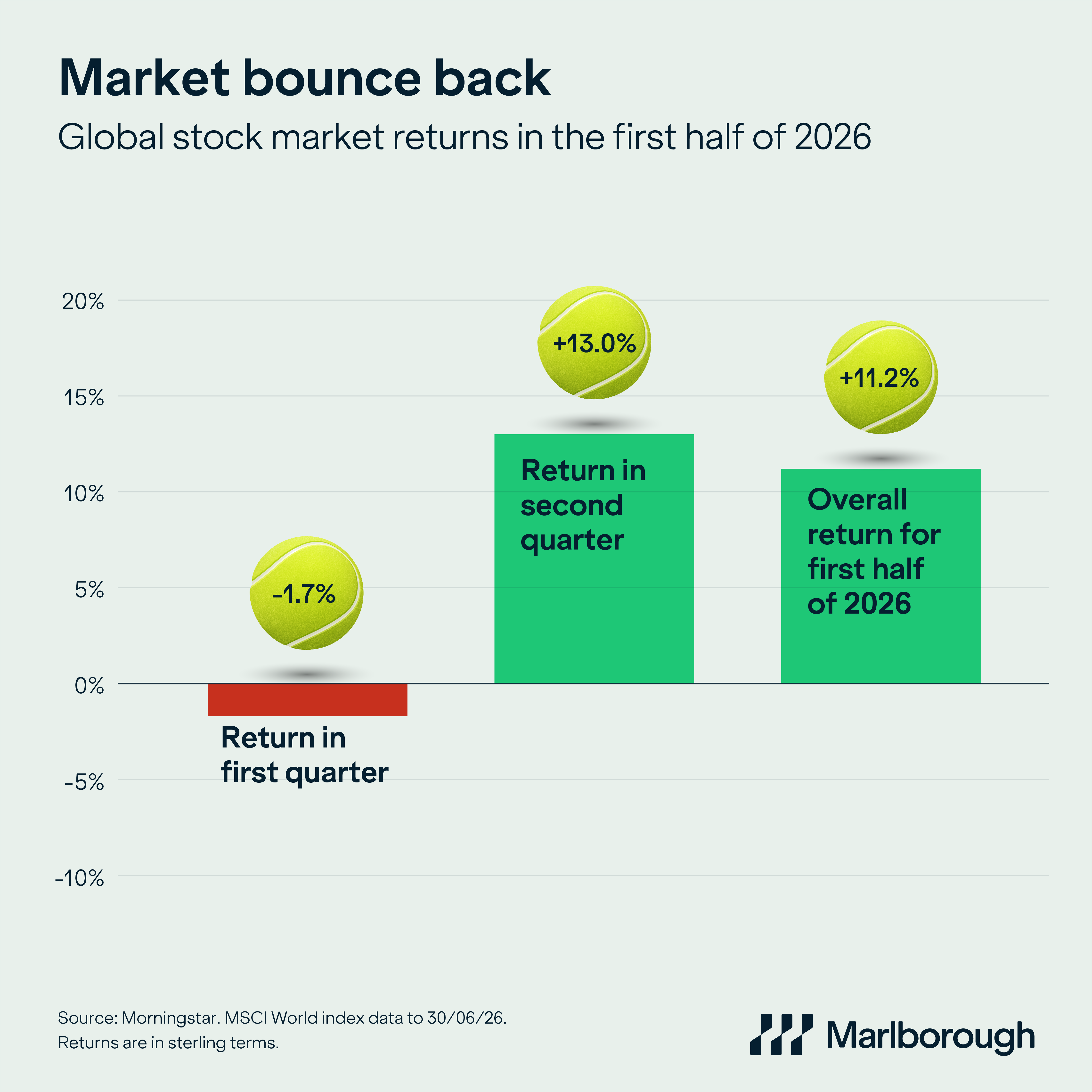
If you only looked at where stock markets finished at the end of June, you might conclude it had been a relatively straightforward period. But, like a tennis scoreline, the headline return hides the drama underneath. The first quarter was difficult, with investors worrying about inflation, tariffs, interest rates and stretched valuations in parts of the market. Then came a strong rebound in the second quarter, helped by resilient earnings, improving sentiment and renewed confidence in key areas of the market.
The point is underlined by this week’s chart. Focusing on the MSCI World stock market index, it shows the contrast between returns in the first and second quarters of the year. The final number matters, but so does the journey. Markets, like tennis matches, are full of momentum shifts.
There’s an important lesson here for investors. It’s easy to overreact to a difficult quarter, just as it’s easy for a tennis player to dwell on a lost point, a missed chance or a poor service game. But the best players move on quickly. They focus on the next point. Investors need to do something similar.
Of course, that doesn’t mean ignoring risk. Some parts of the market, particularly areas linked to artificial intelligence infrastructure, have moved very strongly and may now require a more selective approach. But the key point is to remember that volatility is part of long-term investing. The path is rarely smooth, and the turning points are usually only obvious with hindsight.
In the investment world, the scoreline rarely tells the full story. The first three months of the year had plenty of twists and turns, but investors who stayed disciplined were rewarded as markets recovered in the second quarter. Like the great tennis players, successful investors know they can’t win every point. The crucial thing is to stay invested, understand the value of diversification and remain focused on the long game.
This article is provided for general information purposes only and should not be construed as personal financial advice to invest in any fund or product. These are the investment manager’s views at the time of writing and should not be construed as investment advice. The opinions expressed are correct at time of writing and may be subject to change. Capital is at risk. The value and income from investments can go down as well as up and are not guaranteed. An investor may get back significantly less than they invest. Past performance is not a reliable indicator of current or future performance and should not be the sole factor considered when selecting funds.

