
View
Multi-Asset


Capital is at risk. The value and income from investments can go down as well as up and are not guaranteed. An investor may get back significantly less than they invest. Past performance is not a reliable indicator of current or future performance and should not be the sole factor considered when selecting funds.
By selecting intermediary or institutional investor I confirm that I am a financial professional and understand that the information should not be distributed to or relied upon by any other persons. It’s provided for general information purposes only and is not personal advice to anyone to invest in any fund or product. Information taken from trade and other sources is believed to be reliable, although we don’t represent this as accurate or complete and it shouldn’t be relied upon as such.


It's peak holiday season in the UK, when millions of Brits head off overseas or enjoy a relaxing break closer to home.
Stepping back from the daily routine – taking a break from emails, commuting and the school run – often gives us a little more space to think about the bigger picture. Where do I want to be in five years? When should I retire? Am I on track financially?
Oddly, it's often when we're furthest away from home that we spend the most time thinking about our future.
The problem is that our long-term goals are often competing with a constant stream of short-term headlines. And the temptation is to believe that successful investing requires reacting to every new development and piece of economic news.
Every year we’re subjected to countless dire warnings about economic slumps. These could tempt some investors to question their strategy or even sell up and sit in cash waiting for ‘better times’.
However, our chart this week helps to show the reality behind the headlines. It illustrates just how many times the US economy – the world’s largest economy – actually slipped into recession between the first quarter of 2000 and the first quarter of 2026. In reality, the US spent only 11 quarters in recession. That’s just 11 out of 105 quarters.
It’s important to mention that this is using the official definition of a recession from the National Bureau of Economic Research (NBER), which is an influential independent US organisation dedicated to economic research. The NBER’s definition of a recession is “a significant decline in economic activity that is spread across the economy and lasts more than a few months”. It favours this approach over the more widely used definition of a recession as two consecutive quarters of negative gross domestic product (GDP) growth.
The grey bands show the periods the NBER classified as US recessions, in 2001 (dot.com bubble bursting and business investment slump), 2008 (Global Financial Crisis) and 2020 (COVID-19 pandemic).
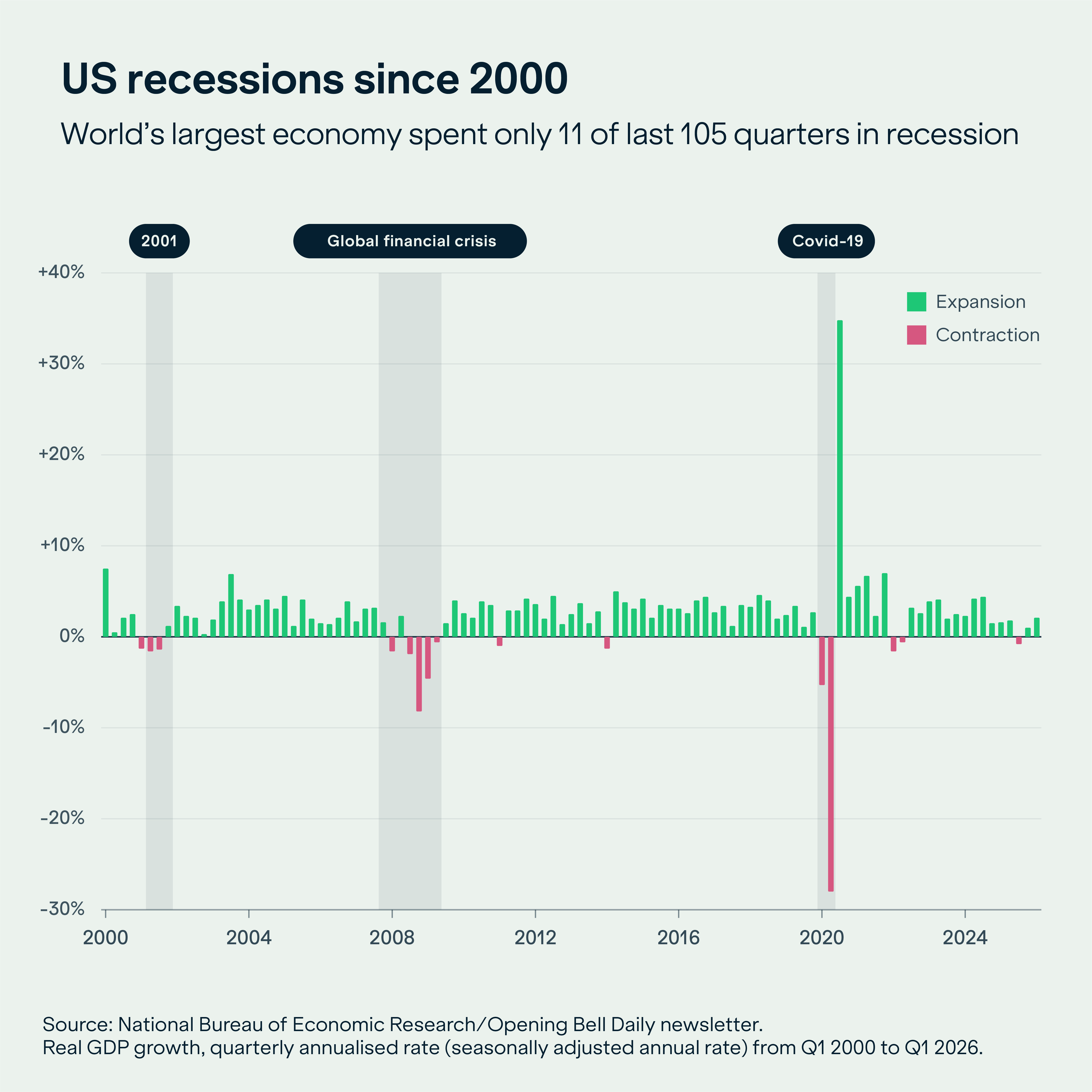
Why does this matter to investors? It shows that for more than a quarter of a century the US economy spent far more time growing than shrinking. There will have been no shortage of times during that period when, fearing an economic slump, investors might have been tempted to try to ‘time the market’ – selling out and buying back in later. But this is notoriously difficult, and the investors risk missing out on significant returns if they get it wrong.
There are, of course, some important caveats. The link between economic growth and stock market returns is a relatively loose one. Markets can fall for a wide range of reasons even when there is no recession, and they can rise even in a recession.
However, for investors the key message is a clear one: don’t let short-term economic or market concerns distract you from your long-term investment strategy. The challenge isn't finding reasons to be worried. There will always be another headline, economic concern or market prediction competing for your attention.
The real challenge is taking a long-term perspective and remaining focused on the destination rather than every bump in the road. Diversified portfolios can help with this. Blending different asset classes like shares and bonds in a multi-asset portfolio is designed to smooth the investment journey.
The most important investment decisions are usually long-term ones. Staying invested, remaining disciplined and focusing on your end goal is likely to be far more effective than trying to predict what will happen next in either the economy or the stock market.
This article is provided for general information purposes only and should not be construed as personal financial advice to invest in any fund or product. These are the investment manager’s views at the time of writing and should not be construed as investment advice. The opinions expressed are correct at time of writing and may be subject to change. Capital is at risk. The value and income from investments can go down as well as up and are not guaranteed. An investor may get back significantly less than they invest. Past performance is not a reliable indicator of current or future performance and should not be the sole factor considered when selecting funds.


