
View
Multi-Asset


Capital is at risk. The value and income from investments can go down as well as up and are not guaranteed. An investor may get back significantly less than they invest. Past performance is not a reliable indicator of current or future performance and should not be the sole factor considered when selecting funds.
By selecting intermediary or institutional investor I confirm that I am a financial professional and understand that the information should not be distributed to or relied upon by any other persons. It’s provided for general information purposes only and is not personal advice to anyone to invest in any fund or product. Information taken from trade and other sources is believed to be reliable, although we don’t represent this as accurate or complete and it shouldn’t be relied upon as such.


At the weekend, we headed off on our annual school class camping trip.
Each year, the group seems to get a little bigger as more families join us for a weekend of fresh air, campfires and a chance to reconnect with nature. It’s always great fun, although ‘surviving in the wilderness’ is probably overstating things when the nearest supermarket is only a short drive away.
One thing that struck me this year was the lack of screen time.
The parents were too busy keeping the fire going, preparing meals, organising games and activities and making sure nobody disappeared into the woods. The children, meanwhile, seemed perfectly content building dens, kicking footballs around and generally finding ways to entertain themselves without staring at a screen.
It felt refreshingly normal.
That observation reminded me of one of the Black Swan scenarios we highlighted at the start of the year: the possibility that Australia’s social media ban for under-16s could spread around the globe.
At the time, Australia had become the first major economy to take steps to introduce restrictions, and many questioned whether the policy could ever be enforced effectively. Our view was that if the initiative was perceived as successful, other countries could quickly follow suit.
Last week, we saw the first signs that this may be happening.
The UK government announced plans to introduce legislation that would ban social media use for under-16s from 2027. Canada is exploring similar measures, while several European countries are also examining tighter restrictions on adolescent social media use.
Our chart this week highlights an interesting reality from Australia’s early experience.
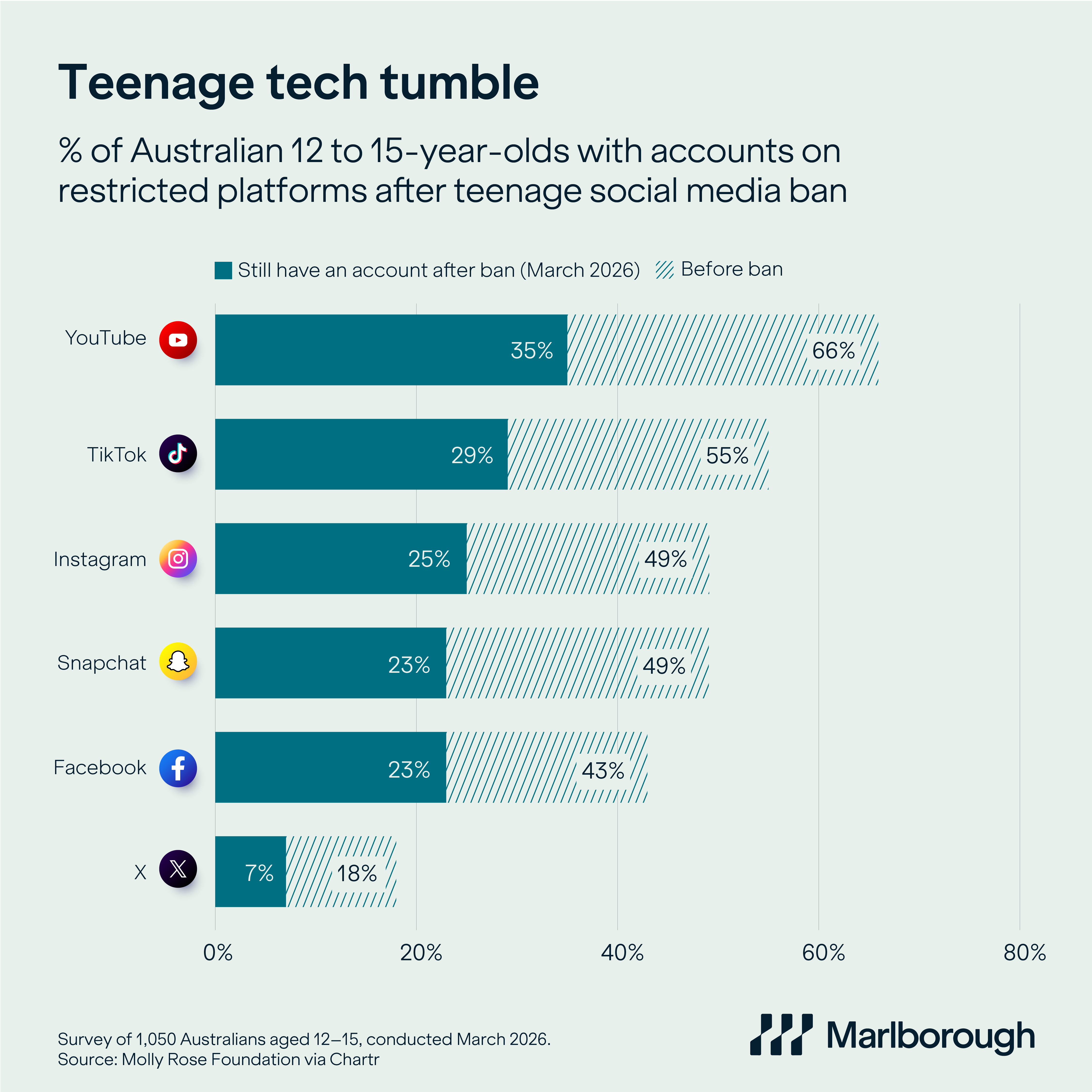
Despite widespread media coverage suggesting the ban has been ineffective, the data tells a more nuanced story. The proportion of 12 to 15-year-olds with accounts on major platforms has fallen materially since the restrictions were introduced, according to a survey by the Molly Rose Foundation. It found YouTube usage has almost halved, and it’s a similar story on TikTok, Instagram, Snapchat, Facebook and X (formerly Twitter).
At the same time though, the figures show millions of teenagers are likely to have found ways around the rules.
In many respects, that shouldn’t be surprising. Teenagers have always been remarkably creative when it comes to bypassing restrictions placed in front of them. The New York Times recently reported stories of Australian teenagers using everything from fake dates of birth to creative age-verification workarounds (drawing moustaches on their photos, for example) to secure access.
For investors, however, the bigger question isn’t whether every teenager can be prevented from opening an account.
The more important issue is whether governments are becoming increasingly willing to regulate digital platforms in the same way previous generations regulated industries such as tobacco, gambling and alcohol.
Some commentators have already drawn comparisons between social media companies and tobacco firms. Both industries have generated enormous profits while facing growing scrutiny over their impact on health and wellbeing.
There are huge differences between these industries, of course. Today’s technology giants are also significantly more diversified than tobacco companies ever were. Meta and Alphabet generate revenues from advertising, messaging platforms, cloud services, artificial intelligence and a growing range of digital products. Even if social media growth slows among younger demographics, these businesses have multiple avenues for future expansion.
That’s why I don’t believe we’re witnessing the beginning of the end for the technology sector. However, investors may eventually need to revisit assumptions around user growth, engagement and advertising revenues if restrictions continue to spread globally.
Markets are exceptionally good at extrapolating trends. Sometimes the most important developments aren’t the immediate impact, it’s the direction of travel that’s key.
Australia may not have solved the problem. But it may have started something.
While the immediate impact of teenage social media bans on the technology giants may be limited, the willingness of governments to regulate digital engagement is increasing. For investors, the key question is not whether today’s teenagers can circumvent the rules, but whether future growth expectations for social media platforms are becoming a little less certain.
This article is provided for general information purposes only and should not be construed as personal financial advice to invest in any fund or product. These are the investment manager’s views at the time of writing and should not be construed as investment advice. The opinions expressed are correct at time of writing and may be subject to change. Capital is at risk. The value and income from investments can go down as well as up and are not guaranteed. An investor may get back significantly less than they invest. Past performance is not a reliable indicator of current or future performance and should not be the sole factor considered when selecting funds.

