
View
Investment Updates


Capital is at risk. The value and income from investments can go down as well as up and are not guaranteed. An investor may get back significantly less than they invest. Past performance is not a reliable indicator of current or future performance and should not be the sole factor considered when selecting funds.
By selecting intermediary or institutional investor I confirm that I am a financial professional and understand that the information should not be distributed to or relied upon by any other persons. It’s provided for general information purposes only and is not personal advice to anyone to invest in any fund or product. Information taken from trade and other sources is believed to be reliable, although we don’t represent this as accurate or complete and it shouldn’t be relied upon as such.



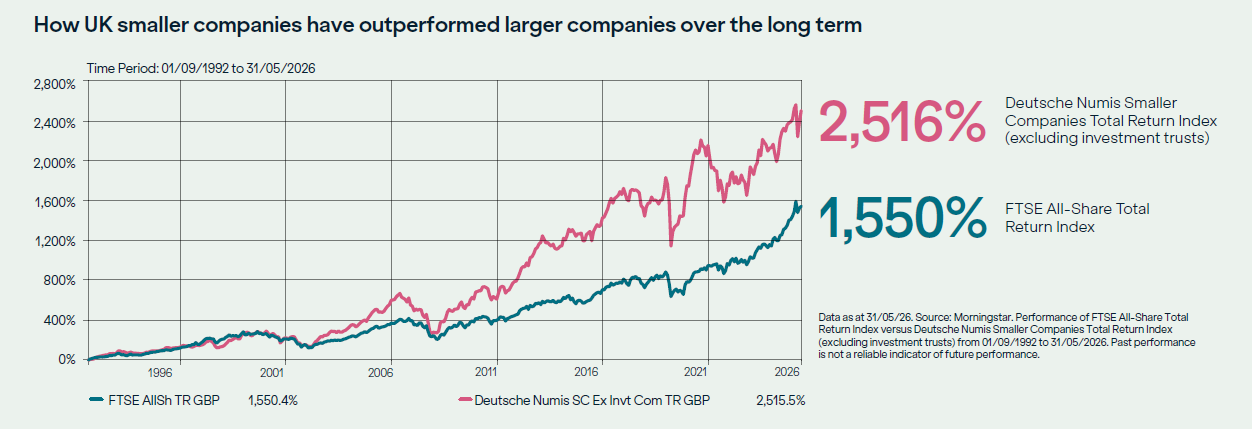
After an exceptionally strong run by US equity markets, which has been driven largely by a limited number of technology mega-caps, the case for looking elsewhere for new opportunities has grown significantly stronger. The value available in the UK smaller companies arena is, we believe, unrivalled. Leading global players in fields from aerospace and defence to energy and life sciences remain modestly valued. Against this backdrop, we believe it is also worth remembering how, as the chart below highlights, UK smaller companies have historically outperformed their larger counterparts over the long term.
Looking back well over 30 years, from 1st September 1992 to 31st May this year, the FTSE All-Share returned just over 1,550%. However, the Deutsche Numis Smaller Companies Index (excluding investment trusts) – which represents the bottom 10% of the main UK stock market by value – returned more than 2,515%.
In our IFSL Marlborough UK Micro-Cap Growth Fund we hold around 170 of the UK’s smallest listed companies. Many of these businesses are world leaders in highly specialised niche industries. Others provide exposure to some of the most exciting areas of global innovation and growth.
Here we highlight three stocks we hold that are at the centre of advances in global technology and that we believe have exceptional long-term growth potential.
Please note that these are the investment manager’s views at the time of writing and the opinions expressed may be subject to change.

Frontier IP provides expertise to enable the commercialisation and funding of attractive intellectual property from universities. It provides strategic, technical and financial services to help spin-out companies grow, in exchange for an equity stake in the business.
One of the key features of our investment process is a focus on management capability, and Frontier’s CEO, Neil Crabb, has a strong track record. This includes working with Exscientia, a company at the forefront of artificial intelligence (AI) driven drug discovery and research. It generated £14m of value for Frontier IP from an initial investment of under £2,000.
The company has strong relationships with leading universities in the UK and Portugal, as well as with individual academics and across the technology industry. It is helping to turn cutting edge research by more than a dozen start-ups into commercial products designed to solve some of the key challenges facing the world.
The explosive growth of AI is driving demand for more powerful technology to speed up data processing and increase the computing power of data centres. Frontier owns a stake of more than 9% in 2D Photonics, which is pioneering the development of graphene chips that can speed up data tra ffic, while significantly reducing energy use.
2D Photonics is a spin-out from a partnership between the University of Cambridge and Italian research institute CNIT. Earlier this year, it was awarded a grant of more than €200m by the Italian government. This grant, which is to help the company scale-up and accelerate the development of its graphene technology, shows the importance European governments place on this work.
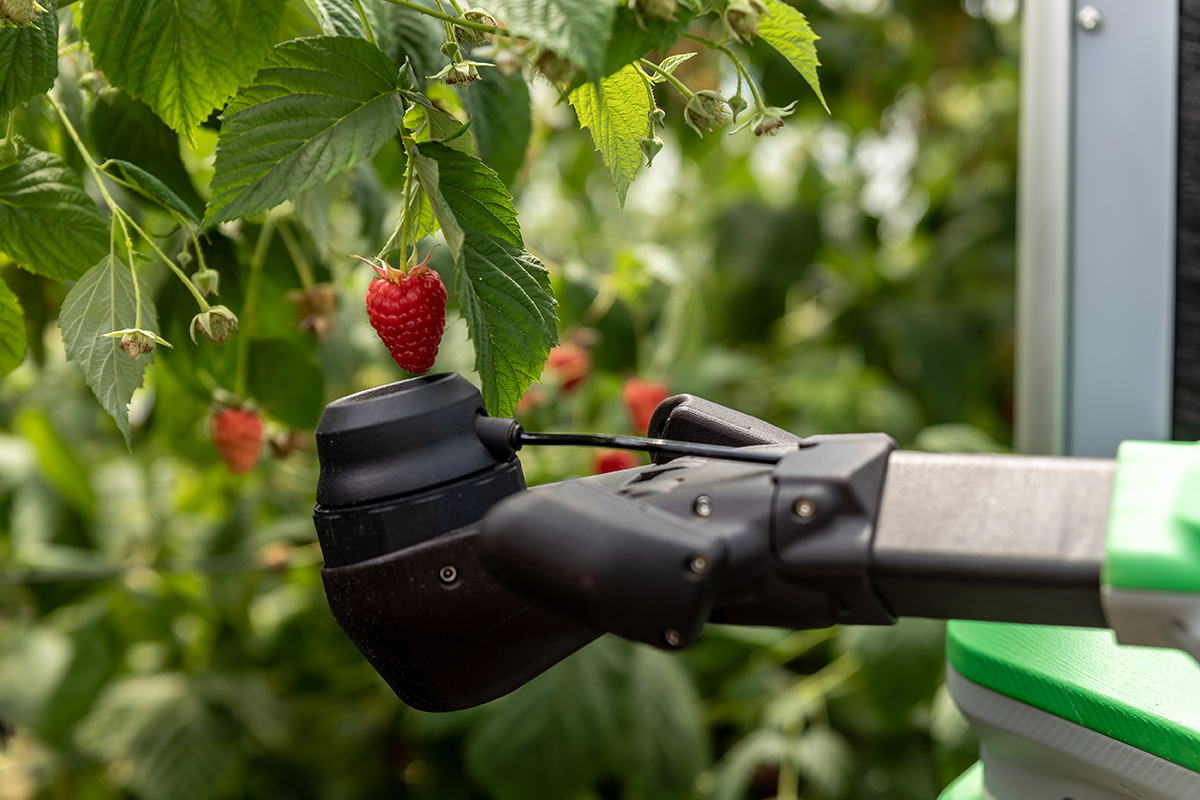
Frontier also owns a stake in Fieldwork Robotics, which has developed robots to pick soft fruits like raspberries. Worldwide, up to 30% of crops are currently left unpicked because of labour shortages. The company’s reduce waste and help farmers around the world continue to produce fruit despite unprecedented labour costs and shortages of pickers.
It has developed a fully autonomous robot to harvest raspberries, the most difficult to pick of all the soft fruits. Raspberries harvested by Fieldwork’s robots are now on sale in UK supermarkets. The company, which is a spin-out from the University of Plymouth, is now developing robots to pick other crops.
Despite providing exposure to a range of cutting-edge technologies and having a net asset value (NAV) per share of around 50p, Frontier IP is trading on a share price of only around 17p (at the time of writing). We believe this represents an attractive long-term opportunity.


Porvair is a good example of a UK small cap that is among the global leaders in its specialist business niche. In this case it is high-performance filters used in a whole range of areas. These include environments where safety is critical, including aviation and space travel.
The company produces highly specialised lightweight components used to filter the fuel in spacecraft engines. This is to avoid contamination by microscopic debris that could otherwise clog systems, reducing thrust or causing an engine to fail completely.
Its components are designed to withstand extraordinarily hostile conditions, including extreme vibration and temperatures that could potentially fluctuate from -269C to 1,000C.
Porvair’s filters are used on the International Space Station, helping to eliminate contaminants in the carbon dioxide removal system. This vital system ensures the air remains breathable for the crew.
Earlier this year, NASA announced a $20 billion programme to build a permanent human-occupied base on the Moon by 2032. Porvair has already produced a filter it believes could be used inside the base.
Back on Earth, the company’s filters are used in most models of commercial aircraft to protect vital equipment including fuel systems and hydraulics. Its products are also used in a range of other fields including the nuclear and pharmaceutical industries.
Despite being a global leader in high-performance filters and having what we believe are strong prospects for further growth, Porvair’s valuation remains attractive. This focus on valuation is an important element in our investment process.
The company’s enterprise multiple – enterprise value divided by EBITDA – is only a little above a ten-year low (at the time of writing).


Seraphim Space Investment Trust is a UK-listed investment vehicle that gives us access to some very exciting unlisted companies in the space industry. One of its holdings is a company called ICEYE, which owns a constellation of satellites used in everything from defence and intelligence work to monitoring natural disasters.
Using advanced radar technology, the satellites provide data enabling governments to understand the impact of floods, wildfires and hurricanes in close to real time, with uninterrupted visibility day or night and in any weather conditions. This allows the authorities to identify the most vulnerable areas and to provide a more effective emergency response.
When Hurricane Melissa swept across the Caribbean last year, ICEYE’s flood impact data helped governments and aid organisations co-ordinate their humanitarian response.
This satellite monitoring capability also has more commercial applications. It enables insurers to quickly understand the scale and severity of natural disasters. This allows them to identify the hardest-hit areas and accelerate payments to those affected. In addition, the technology enables insurers to identify high-risk locations before disasters strike, allowing them to make better-informed underwriting decisions.
Another company in the Seraphim portfolio is Zeno, which is building a new generation of nuclear batteries that can provide years’ worth of power for spacecraft and equipment operating at the bottom of the Earth’s oceans.
Other holdings include SatVu, which has developed high-resolution satellite-borne thermal imaging technology powerful enough to show the heat signature of any building on Earth.
This could provide valuable new economic and energy effi ciency insights. Seraphim also holds D-Orbit, which operates ‘space tugs’. These carriers put new satellites into position and decommission old ones by ensuring they safely re-enter the Earth’s atmosphere and burn up.

Eustace Santa Barbara is co-manager of the IFSL Marlborough Special Situations, UK Micro-Cap Growth and Nano-Cap Growth Funds.
This article is provided for general information purposes only and should not be construed as personal financial advice to invest in any fund or product. These are the investment manager’s views at the time of writing and should not be construed as investment advice. The opinions expressed are correct at time of writing and may be subject to change. Capital is at risk. The value and income from investments can go down as well as up and are not guaranteed. An investor may get back significantly less than they invest. Past performance is not a reliable indicator of current or future performance and should not be the sole factor considered when selecting funds.


