
View
Multi-Asset


Capital is at risk. The value and income from investments can go down as well as up and are not guaranteed. An investor may get back significantly less than they invest. Past performance is not a reliable indicator of current or future performance and should not be the sole factor considered when selecting funds.
By selecting intermediary or institutional investor I confirm that I am a financial professional and understand that the information should not be distributed to or relied upon by any other persons. It’s provided for general information purposes only and is not personal advice to anyone to invest in any fund or product. Information taken from trade and other sources is believed to be reliable, although we don’t represent this as accurate or complete and it shouldn’t be relied upon as such.


I was fortunate enough to spend time in both Singapore and Hong Kong last week. What struck me wasn't just the scale of development, but the pace.
New skyscrapers, modern transport networks, artificial intelligence (AI) infrastructure, thriving businesses and a palpable sense of economic momentum were everywhere. It was a reminder that while investors often view the world through a US lens, growth and innovation are increasingly coming from multiple directions.
The fact the US now has to compete harder for investors’ attention may also have influenced the decision by the US Federal Reserve (the Fed) to raise interest rates last week.
Historically, higher interest rates are used to cool an overheating economy. Yet today's inflation pressures are not solely domestic. Energy prices around the world have been pushed higher by conflict in the Middle East, food prices remain vulnerable to climate disruptions, and the global race to build AI infrastructure has created enormous demand for technology components and power.
Increasing US interest rates won't produce more oil, improve harvests or reduce demand for data centres. So why raise them?
One reason may be that the Fed is increasingly conscious of the need to maintain demand for US government bonds. Foreign investors have long played a crucial role in financing America's borrowing needs. As interest rates rise elsewhere and investment opportunities broaden across the world, the US can no longer take attracting global capital for granted. And if the Fed raises interest rates, this tends to have the effect of pushing up the yield* available on US government bonds, particularly shorter-dated ones**.
The US is now facing competition on many fronts. Technological leadership, for example, is no longer a one-horse race. Last week, Chinese AI firm DeepSeek demonstrated further efficiency gains that challenged assumptions about the ever-growing demand for computing power. Whether it ultimately changes the competitive landscape remains to be seen, but it serves as another reminder that innovation is becoming more widely distributed geographically.
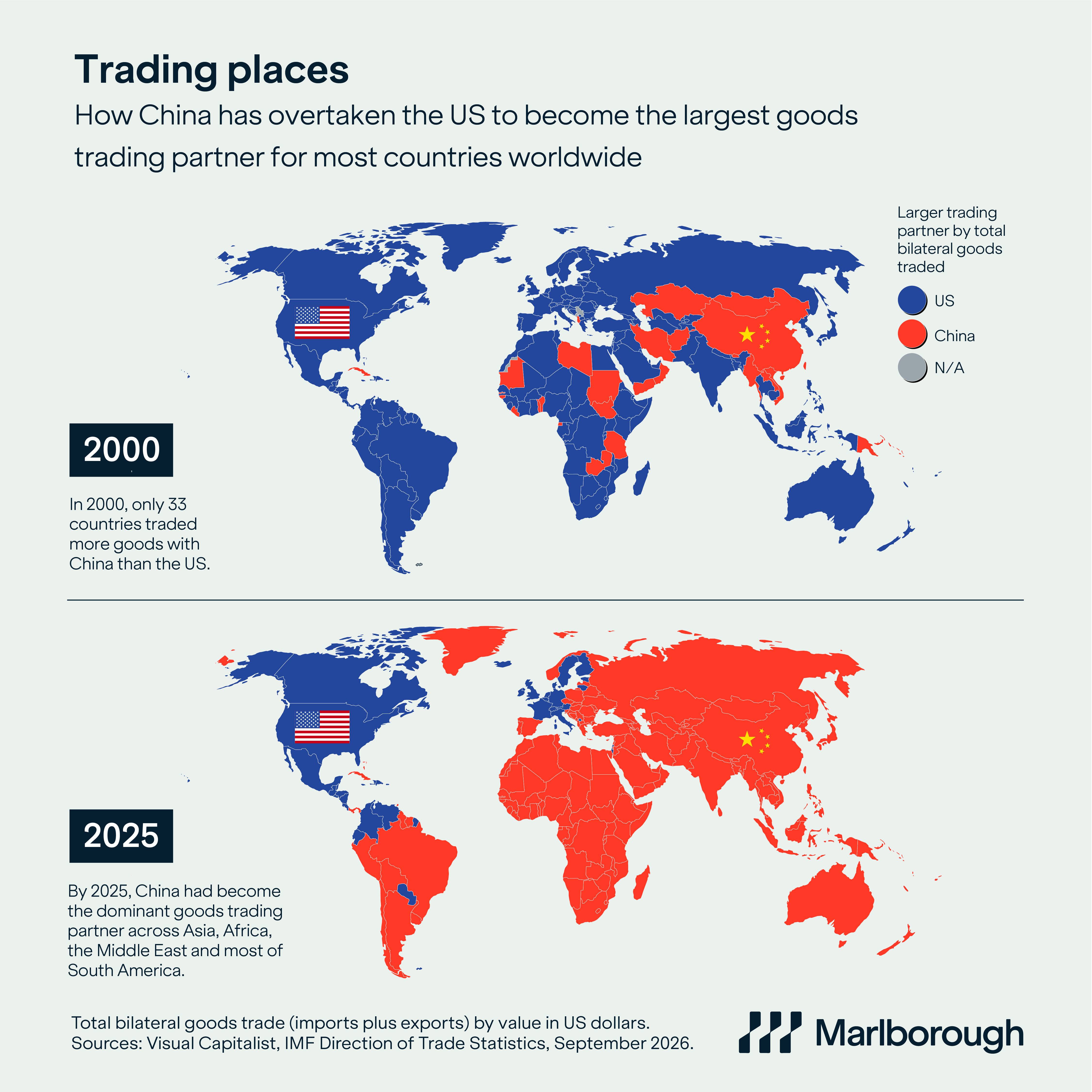
Our chart this week illustrates perhaps the biggest shift of all. Just over 25 years ago, the US was the dominant goods trading partner for much of the world. Today, China occupies that position across Asia, Africa, the Middle East and most of South America.
This doesn't mean America is in decline. The US remains home to some of the world's most innovative companies and its stock market offers a huge range of opportunities. This is why the US is the largest equity allocation in our multi-asset portfolios. The increase in the value of the US stock market also means that its representation in global stock market indices like the MSCI World has grown significantly in recent years.
Nonetheless, the trade data highlighted in our chart suggests we are moving away from a world in which the US economy sets the direction and everyone else follows.
Investors are navigating a more multipolar world, where economic influence, innovation and growth increasingly come from several regions rather than one.
Our chart shows how global trade has evolved. The Fed's rate rise may be another reminder that the balance of global economic power is changing.
This article is provided for general information purposes only and should not be construed as personal financial advice to invest in any fund or product. These are the investment manager’s views at the time of writing and should not be construed as investment advice. The opinions expressed are correct at time of writing and may be subject to change. Capital is at risk. The value and income from investments can go down as well as up and are not guaranteed. An investor may get back significantly less than they invest. Past performance is not a reliable indicator of current or future performance and should not be the sole factor considered when selecting funds.

