
View
Multi-Asset


Capital is at risk. The value and income from investments can go down as well as up and are not guaranteed. An investor may get back significantly less than they invest. Past performance is not a reliable indicator of current or future performance and should not be the sole factor considered when selecting funds.
By selecting intermediary or institutional investor I confirm that I am a financial professional and understand that the information should not be distributed to or relied upon by any other persons. It’s provided for general information purposes only and is not personal advice to anyone to invest in any fund or product. Information taken from trade and other sources is believed to be reliable, although we don’t represent this as accurate or complete and it shouldn’t be relied upon as such.


The beginning of the new year is always a natural pause point. A chance to reflect on the 12 months that have just ended and to look forward to what the year ahead might hold. In investing, as in life, that forward-looking instinct is powerful. We all want to know what’s coming next.
As we start the new year, we’re optimistic about the outlook for 2026. We’ll be setting out our full thinking in our ‘2025 Review and 2026 Outlook’. But for this first Chart of the Week of the year, we thought we’d take a slightly different angle and look at the betting on prediction markets.
Prediction markets, such as Polymarket, allow participants to bet money on future outcomes, from economic growth and interest rates to stock market flotations and company leadership changes. Unlike surveys or opinion polls, these markets require participants to put their capital at risk, which tends to encourage more disciplined thinking that’s firmly rooted in an individual’s assessment of probabilities.
They’re not forecasts in the traditional sense, and they’re certainly not investment advice. But they can offer a useful snapshot of how collective expectations are forming, particularly around big events.
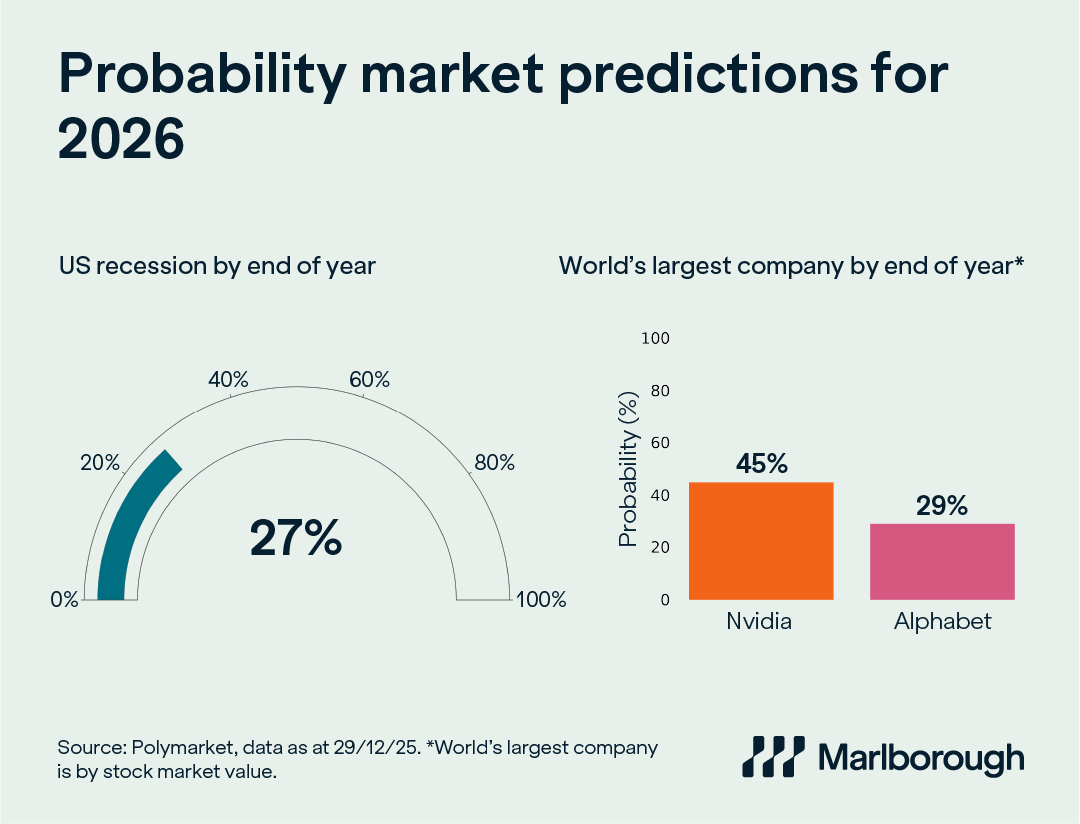
Using Polymarket data, a few themes stand out:
• Continued confidence in US economic growth
As our graphic shows, Polymarket’s customers believe there is a relatively low probability of a US recession by the end of 2026. This aligns with our own view that, while growth may be uneven, the global economy is more likely to muddle through than slip into a deep downturn.
• Continuing confidence in AI-led growth
Markets see a race between chip giant Nvidia and Google parent Alphabet to be the world’s largest company (by stock market value) by the end of 2026. This reflects ongoing confidence in artificial intelligence (AI) led growth but also hints at a broader spread of returns within the technology sector rather than a single company dominating stock market performance.
• Interest rates and central bank policy still matter
One of the most actively traded prediction market bets globally is the identity of the next Chair of the Federal Reserve, the US central bank. This may sound surprising, but it underlines just how important central bank policy remains to market outcomes and how sensitive investors are to the future path of interest rates.
It’s worth highlighting an important distinction. Prediction markets (like gambling) are ultimately zero-sum. For every winner, there’s a loser. Long-term investing is different. Over time, diversified exposure to investment markets has consistently created value, even if the path has been bumpy.
That’s why, while we find prediction markets interesting as a tool to gauge sentiment, our portfolios remain built around consistent long-term strategy, diversification and disciplined risk management, not short-term bets on specific outcomes.
As we head into 2026, markets appear more optimistic than pessimistic. Growth is expected to continue, interest rates are likely to fall gradually and stock market performance may broaden beyond a narrow group of winners. That’s a constructive backdrop for diversified multi-asset portfolios.
If you’d like to explore our expectations for the year ahead in more detail, please look out for our ‘2025 Review and 2026 Outlook’.
This article is provided for general information purposes only and should not be construed as personal financial advice to invest in any fund or product. These are the investment manager’s views at the time of writing and should not be construed as investment advice. The opinions expressed are correct at time of writing and may be subject to change. Capital is at risk. The value and income from investments can go down as well as up and are not guaranteed. An investor may get back significantly less than they invest. Past performance is not a reliable indicator of current or future performance and should not be the sole factor considered when selecting funds.

