
View
Multi-Asset


Capital is at risk. The value and income from investments can go down as well as up and are not guaranteed. An investor may get back significantly less than they invest. Past performance is not a reliable indicator of current or future performance and should not be the sole factor considered when selecting funds.
By selecting intermediary or institutional investor I confirm that I am a financial professional and understand that the information should not be distributed to or relied upon by any other persons. It’s provided for general information purposes only and is not personal advice to anyone to invest in any fund or product. Information taken from trade and other sources is believed to be reliable, although we don’t represent this as accurate or complete and it shouldn’t be relied upon as such.


I’m sure I’m not the only one who’s been fascinated by Sabastian Sawe’s historic achievement in the London Marathon.
For years, breaking the two-hour marathon barrier felt just out of reach. Not impossible, but requiring everything to align: pace, conditions and technical innovation.
And then, suddenly, the barrier was smashed – and not once but twice.
Two runners – Sawe and Yomif Kejelcha – finished the 26.2-mile course in less than two hours. It was, frankly, quite remarkable.
It’s worth remembering that marathons aren’t won by sprinting early. They’re won by careful planning, managing energy and adapting to changing conditions.
Something similar seems to be playing out in the oil market. As we’re all only too aware, tanker traffic through the Strait of Hormuz has been largely halted.
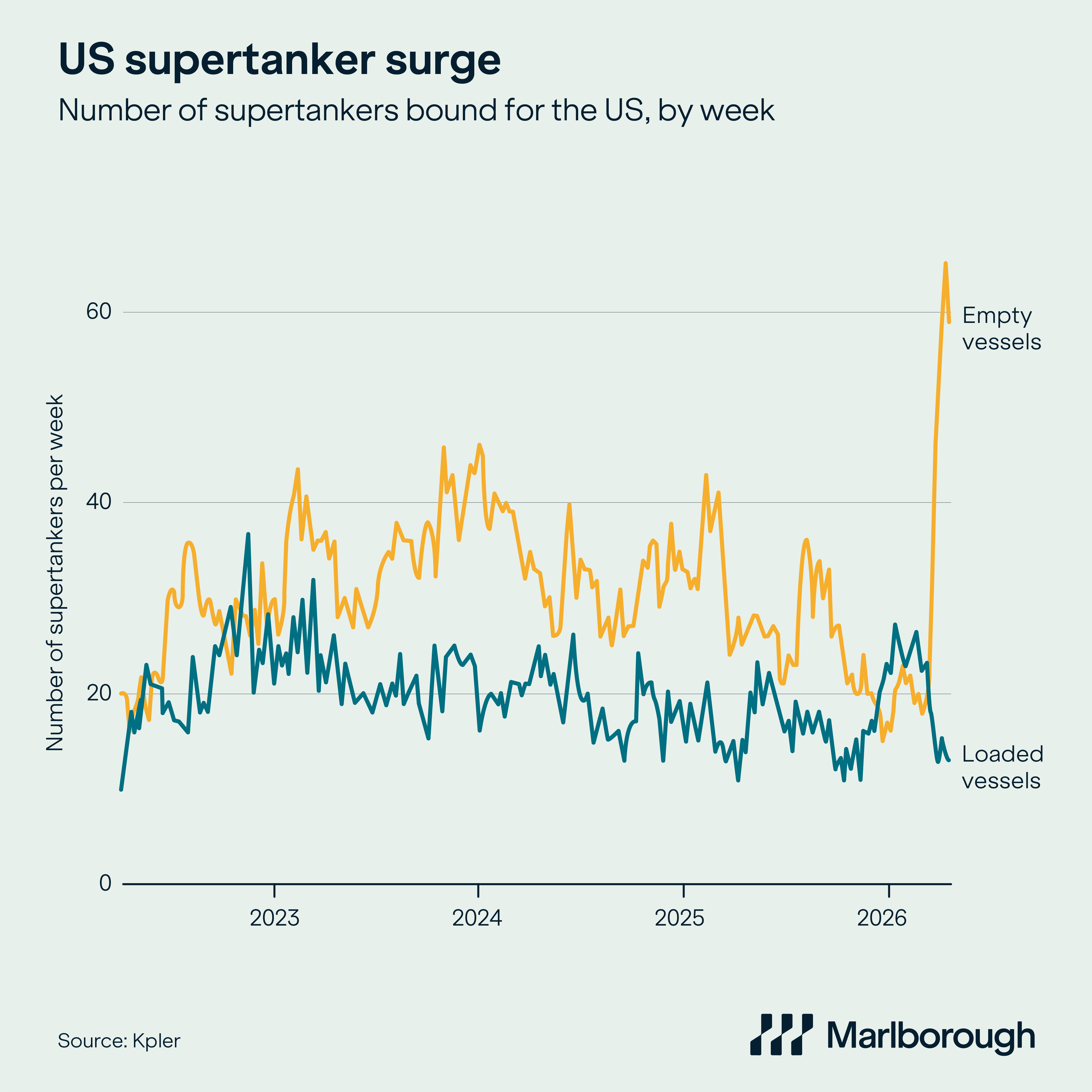
Now though, dozens of large empty crude tankers are heading towards the US. Oil exports from the US have surged since the blockade of the Strait of Hormuz began, with American oil companies capitalising on a sudden surge in demand.
While US oil exports can’t fully replace the supplies halted by the blockade, what’s happening reminds us of an important truth about the oil market. When a key supply route closes, the system doesn’t stop. It adjusts to try to keep up with the pace of demand.
This week’s chart highlights the dramatic increase in the number of empty oil supertankers, which can carry two million barrels of oil, heading to the US. The country is, after all, the largest producer of oil in the world and today it has no shortage of customers.
There’s another interesting dimension to the oil supply squeeze, which is the increasing demand for energy to power artificial intelligence (AI) systems. According to Forbes magazine, fossil fuels including oil and gas currently generate about 60% of the energy used by the vast datacentres that power AI.
So, at the same time oil and gas supplies are coming under pressure, the huge growth in the use of AI is creating a rapidly growing new source of demand.
In effect, a new runner has joined the race. One that doesn’t tire but keeps asking for more fuel to sustain a faster pace.
Breaking the two-hour marathon barrier wasn’t about speed alone. It was about using energy well and maintaining a solid pace.
The oil market is trying to do the same, with supply routes adapting to try to keep up with the pace of demand.
This article is provided for general information purposes only and should not be construed as personal financial advice to invest in any fund or product. These are the investment manager’s views at the time of writing and should not be construed as investment advice. The opinions expressed are correct at time of writing and may be subject to change. Capital is at risk. The value and income from investments can go down as well as up and are not guaranteed. An investor may get back significantly less than they invest. Past performance is not a reliable indicator of current or future performance and should not be the sole factor considered when selecting funds.

