
View
The Bond Bulletin


Capital is at risk. The value and income from investments can go down as well as up and are not guaranteed. An investor may get back significantly less than they invest. Past performance is not a reliable indicator of current or future performance and should not be the sole factor considered when selecting funds.
By selecting intermediary or institutional investor I confirm that I am a financial professional and understand that the information should not be distributed to or relied upon by any other persons. It’s provided for general information purposes only and is not personal advice to anyone to invest in any fund or product. Information taken from trade and other sources is believed to be reliable, although we don’t represent this as accurate or complete and it shouldn’t be relied upon as such.


fal·lacy: a mistaken belief, especially one based on unsound arguments:
"The notion that the camera never lies is a fallacy"
I never cease to be amazed by the ability of large groups of otherwise informed, experienced and sensible people to hold a collective belief in something that just is not correct. This occurs in all walks of life. Often these mistaken beliefs start with a grain of truth, which is then lost in the expansion and extrapolation of the fallacious theory that germinates from that single seed. On other occasions, an old wives’ tale continues doing the rounds long after science has poked elephantine holes in it. On this point, doctor and science writer Tim Spector has done an excellent job rebutting the old maxim that one should breakfast like a king, lunch like a prince and dine like a pauper. If you have not read his excellent work, I highly recommend it, particularly because there are so many valid parallels between our attempts to understand the body and our attempts to understand the economy.
When it comes to financial markets, the fallacies tend to come from one of two sources. The first is the subject of economics. More specifically the sort of stylised, model-driven and utterly abstract macroeconomics practised (and preached) in academic institutions, central banks, banks, asset managers and research departments across the globe. The second is a sort of lazy heuristic thinking. This is simplistic and logical-sounding reasoning that simply belies a lack of deep understanding or an unwillingness to battle with the less clean and definitive reality that is our modern monetary and financial system.
There are two such fallacies doing the rounds at the present time and I think both can lead to seriously wrong-headed thought processes and conclusions – and unwanted outcomes.
The lady doth talk too much
Let us start with my nemeses at the world’s central banks (of course, they do not know they are my nemeses, nor would they care if they did). There is a belief that has become an article of faith – the received wisdom, if you will – proposed and propounded in the corridors of academic power and subsequently internalised the world over. This is that central bank communication is a necessary weapon in the monetary policy arsenal.
Initially, the notion was that if central banks were to openly communicate with economic and financial market actors, and (this is the crucial bit) in doing so make clear their reaction functions, then the journey between policy changes would be smoothed by market participants. They would effectively mimic the central bankers with respect to how they imbibed and interpreted incoming information. Market pricing of expected future monetary policy would become more efficient. This would result in fewer twists, turns and shocks and ultimately in better transmission of monetary policy and thus better economic outcomes.
It sounds logical, it sounds sensible and most importantly, to many people, it sounds eminently achievable.
I put it to you my dear reader that instead it is utter hogwash.
Central bankers, like economists, are a heterogenous bunch. Economics is replete with competing theories about how the world works and as such for any given state of the economy you can probably find a well-credentialled economist to support just about any remotely reasonable course of action. The committees that collectively decide on monetary policy have demonstrated a commensurate dispersion of views. Thus, investors find themselves bombarded with confusing and conflicting speculation from a broad range of policy makers. Each has a different outlook for the economy but also has a different core view as to how to weigh up the various competing influences on their decision.
Often these various views are summarised as being either ‘hawkish’ (tending towards wanting to control inflation) or ‘dovish’ (tending towards wanting to maintain low unemployment and economic growth). What they never are is additive. You cannot simply combine the various views to calculate a reaction function for the central bank. What tends to happen instead is that investors are simply forced to update their best guess at an accurate overall reaction function. This is done by simply updating their expectations (and thus market pricing) in a Bayesian fashion as we hear from everyone in turn. Unsurprisingly, at times of significant economic uncertainty this process actually creates volatility rather than reducing it.
Now personally I do not think volatility is the enemy in the way that many modern economics wonks do. A system is more robust when it is tested by many small shocks along the way, rather than supressing those smaller shocks until they result in one big shock. Volatility helps prevent large build ups of lazy leverage, and it is just about always leverage which causes a blip to become a financial crisis. That though is not the point. The point is that we only suffer through the barrage of self-important central bank pronouncements and prognostications on the basis that it is good for us, as investors. And also the belief that it is good for society because it creates clarity, transparency and lower volatility. It simply does not. For anyone who doubts me, just look at the Bank of England’s communiques of the last few years. They are the literary equivalent of a Jackson Pollock painting.
The comms-fest does not end there. In the period after the Global Financial Crisis, central banks were ‘forced’ to cut rates to (and in some cases below) 0%. This was to aid the clean-up of the mess created by the leverage and misallocation of capital they had themselves helped create with their previous era of inappropriately easy money.
In so doing, they were putting their faith in another fallacy popular in modern macroeconomic circles – that low rates and easy money are the answer to any and all economic problems. The truth is probably closer to the opposite and there are all manner of (currently unfashionable) economic schools of thought which convincingly repudiate this idea.
Empirically, there is a lot of evidence that low rates quickly started to have the opposite effect to the one desired. Saving in Germany went up in response to negative rates, as opposed to the decrease that theory predicts. However, when rates at 0% did not have the desired effect, these masters of the monetary universe refused to be powerless and thus sought ‘unconventional’ tools to try and stimulate economies still suffering from their previous attempts at stimulus.
Quantitative easing (buying assets to juice the stock market and thus encourage pro-cyclical behaviour by increasing wealth and increasing confidence) became the policy du jour. Of course, that did not work either. But never let empirical failure stand in the way of an economist scorned.
One of the problems, so we were told, was that if central banks were implementing such powerful and inevitably successful reflationary policies then financial markets would respond accordingly and begin to price in the eventual re-tightening of policy. In effect, markets would start to tighten policy before central banks were ready, through an increase in bond yields.
Thus, in order to turbo charge the stimulatory effects of these asset purchase policies, the monetary authorities embraced the idea of ‘forward guidance’. This meant making public commitments to financial markets that they would not tighten monetary policy for a period of time or until some key economic criteria were satisfied. Of course, it all collapsed into a mess of contradiction, fear of being the party pooper and broken promises. However, central banks generally mark their own homework so, naturally, repercussions were notably absent.
The problem with forward guidance is that it is very hard for central bankers to know what to do today let alone what to do in three, six or 12 months’ time. Monetary policy works with ‘long and variable lags’ and economic data is itself subject to a significant lag. So today central bankers have some vague idea about what the economy looked like a month ago and a slightly better idea of what it looked like 12 months ago. They then have to use this information to make a decision about policy changes today which will affect the economy in three, six and 12 months’ time. If you then ask them to think about decisions they might make well into the future, you may be straying into similar territory to astrology in terms of accuracy and reliability.
I write all this today because the US Federal Reserve has a new Chair – a former Fed governor by the name of Kevin Warsh. I think he could make an excellent Fed Chair because he thinks independently, he thinks critically and he seems to be guided by an assessment of reality rather than the fantasy contained within economics textbooks. One of his cornerstone policy suggestions is that the Fed should communicate less. I think much of the resulting pushback from the usual talking heads is probably driven by Mr Warsh’s association with the ever-unpopular President Donald Trump (Mr Trump nominated Mr Warsh for the position). However, some of it is, I fear, driven by a lazy embrace of the fallacious received wisdom that central bank communication is an effective and integral part of the necessary monetary toolkit. To that I say simply – it really is not.
Money on the sidelines
Just this morning I heard a very well-known, very well-respected and very experienced fixed income investor talking on one of the financial TV channels. I found most of his views to be thoughtful and reasonable with an attractive mix of consensus and counter-consensus conclusions. This is my usual verdict when I listen to the gentleman in question.
Then he said something which made me shake my head. And he is not alone. It is the sort of thing I hear and read all the time.
Investors, strategists and presenters talk about money flowing into this asset class and out of that asset class and in recent times they will often talk about ‘cash on the sidelines’. This is usually as they spout a laundry list of reasons why we should continue to pile our savings into overpriced, over owned, narrow and increasingly vulnerable stock markets.
The stat generally given is assets under management in money market funds. For the sake of ease, and because it is by far the dominant investment destination, lets just talk about the US. The amount of money in US money market funds is huge. Based on data from Bloomberg (other data providers are available), the most up-to-date figure available is $7.8 trillion. Yes, that’s trillion with a ‘t’.
For comparison, US annual GDP is around $30 trillion.
The heuristic thinker looks at this money, earning a minimal (but safe) return from the very short-dated and very high-quality bonds that money market funds invest in, and thinks ‘What if….?’. What if that money were instead invested in the stock market?
Their assumption is that this almost $8 trillion represents a bunch of investors previously too scared to buy stocks but who will soon be FOMO’d out of their cautious stance and flood into the Nasdaq or S&P 500. Their thinking goes that this would propel prices higher and higher, raining untold wealth on all those wise enough to ignore all historical points of reference and remain fully and completely invested in the US stock market.
Alas, this type of thinking misses a crucial point. Every asset is always owned. And for every buyer, there is a seller. Let us say I take my life savings of $2,500 out of that dull and boring (but safe) money market fund (for ease I shall call this ‘cash’, since to all intents and purposes it is). Swallowing the Kool-Aid in big gulps, I then push all my chips into the US equity market, which is already sitting at all-time highs. I have swapped my cash for someone else’s equities. The amount of money in the stock market has not changed, nor has the amount of cash in the system. I used to have cash now I have stocks. The seller of those stocks used to have stocks and now they have cash.
It is not money flowing into or out of asset classes that drives the price higher or lower. It is the motivation of the buyer and seller. Motivated buyers facing unmotivated sellers will, all else being equal, drive prices higher. And vice versa. But in all cases the amount of money does not change. In fact, the amount of money in the system is a function of central bank policy and credit creation by commercial banks. So, if folk think there is too much money on the sidelines it is likely that this reflects the fact that monetary conditions are, or have been, too easy.
Logically this suggests that there is a money illusion here. Easy money creates inflation in the economy and inflation in asset prices. It rarely creates lasting real worth (and often ends up destroying it).
So how much of that around $8 trillion of money market assets is simply a function of easy money policies driving up prices? It is impossible to be precise in delivering that assessment but here are two ratios which might provide useful indications of the answer.
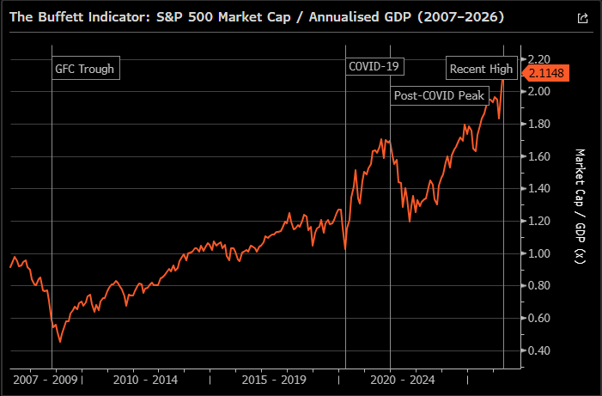
Firstly, we have what is often known as the Buffett Indicator (named, of course, after the Sage of Omaha, legendary investor Warren Buffett). This simply divides the US stock market by US GDP. Sure, there are plenty of holes one can pick in it – not least it fails to account for the overseas earnings of US companies. But it still helps to bring some sort of real value-added frame of reference to the level of the stock market.
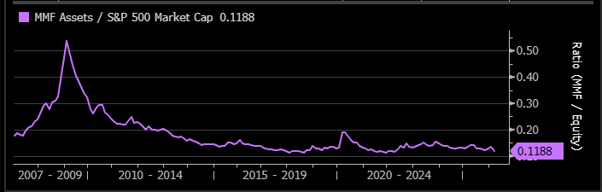
The second ratio is the ratio of US money market assets to the S&P 500 total market capitalisation.
If the stock market capitalisation is a multiple of US GDP and money market assets are a small fraction of stock market total capitalisation then I would say that is a pretty decent prima facie case showing the money illusion is playing a significant role. See for yourselves and, in the meantime, enjoy the World Cup!
This article is provided for general information purposes only and should not be construed as personal financial advice to invest in any fund or product. These are the investment manager’s views at the time of writing and should not be construed as investment advice. The opinions expressed are correct at time of writing and may be subject to change. Capital is at risk. The value and income from investments can go down as well as up and are not guaranteed. An investor may get back significantly less than they invest. Past performance is not a reliable indicator of current or future performance and should not be the sole factor considered when selecting funds.


