
View
Multi-Asset


Capital is at risk. The value and income from investments can go down as well as up and are not guaranteed. An investor may get back significantly less than they invest. Past performance is not a reliable indicator of current or future performance and should not be the sole factor considered when selecting funds.
By selecting intermediary or institutional investor I confirm that I am a financial professional and understand that the information should not be distributed to or relied upon by any other persons. It’s provided for general information purposes only and is not personal advice to anyone to invest in any fund or product. Information taken from trade and other sources is believed to be reliable, although we don’t represent this as accurate or complete and it shouldn’t be relied upon as such.


Things move quickly in the UK at this time of year. It seems like one moment, it’s Halloween and excited trick-or-treaters are knocking on the door. The next, Bonfire Night fireworks are exploding overhead. Then, before you know it, Christmas trees are springing up all around and the run-up to the festive season is well underway.
Things can change rapidly in the investment world too, as last week’s market pullback demonstrated very clearly. Chipmakers and other artificial intelligence (AI) infrastructure stocks have performed strongly this year. But that suddenly changed after the Democrats’ sweeping victories in the US midterm elections.
Investors are concerned the Democrats will slow down the US build-out of data centres, the vast buildings filled with computers that provide much of the processing power AI needs. These fears led to a sell-off in technology companies, which spread to wider markets.
Confidence in the AI sector wasn’t helped by the news at the weekend that Jensen Huang, Chief Executive of chipmaking giant Nvidia, had an affair with a woman who US intelligence chiefs believe was a spy for the Chinese government. Investors were absorbing that news today.
In our view, the pullback caused by the Democrats’ midterm victories was markets doing what they do. That is, pricing in a risk something might happen, long before the eventual outcome is known. The Democrats may increase regulation around the building of data centres. Crucially, though, we believe that, while costs may rise and timelines lengthen, new data centres will still be built.
Our chart shows, state by state, the extraordinary scale of data centre building planned across the US, based on the amount of electricity these facilities are expected to consume. Data centre capacity is measured in megawatts and gigawatts because power, and specifically securing electricity grid connections, has become the primary physical constraint on development. Power use is also a better measure of a facility’s computing capacity than its floor space.
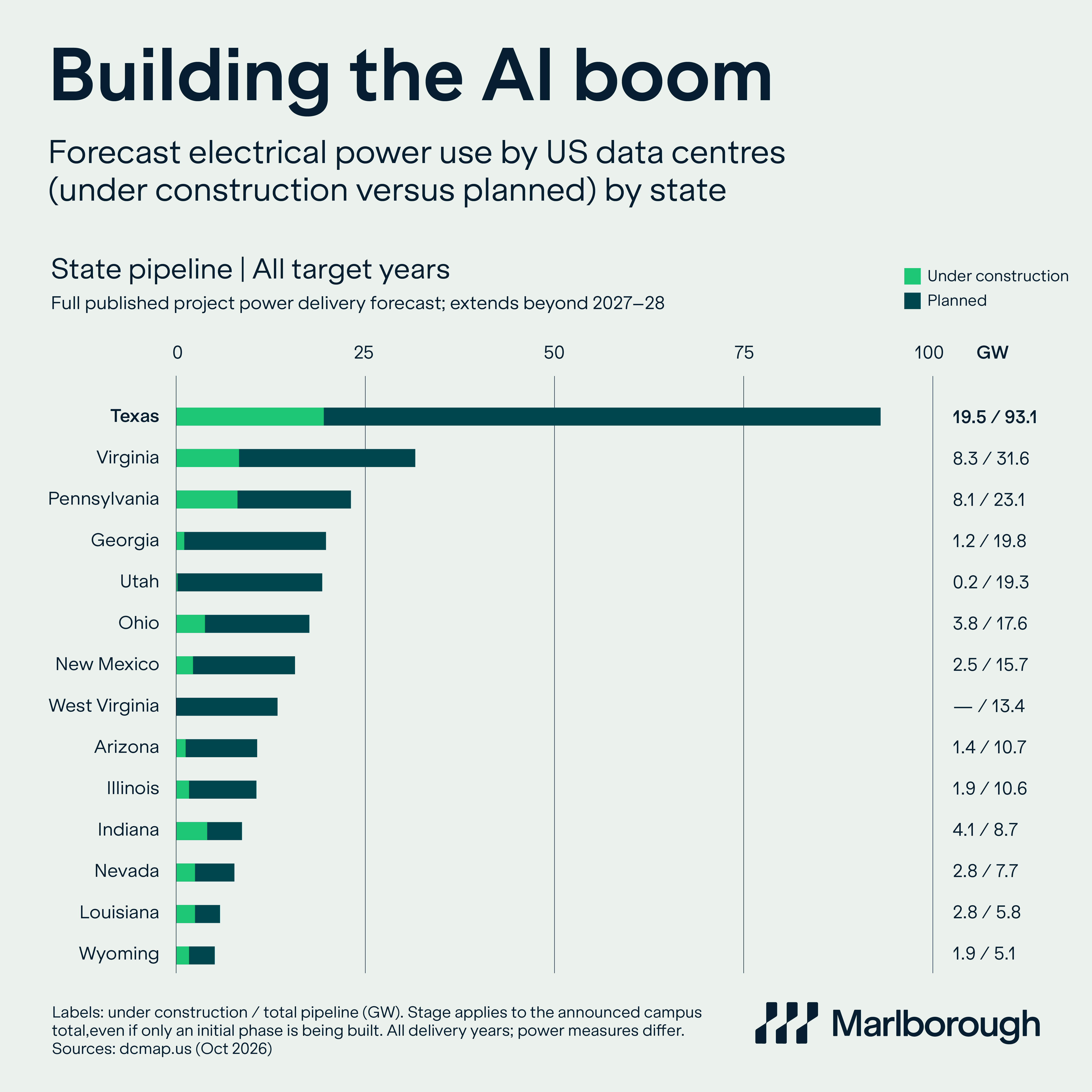
Many of the concerns about data centres surround the enormous amounts of electricity, as well as land and water, they need. This has led to fears in some communities about pressure on power grids, electricity bills and water supplies.
Texas is a good example. This is where around 30% of US data centres are being built. But the state’s Democratic governor-elect, Gina Hinojosa, won power after campaigning for a temporary halt to new approvals until greater protections can be put in place for local communities.
Ultimately, we don’t believe the election of Ms Hinojosa or other Democrats with similar views means the AI boom is over. Technology companies may have to pay more towards the electricity infrastructure their developments require, while offering greater benefits to communities in return for hosting them. But data centres will still be built.
We aren’t abandoning the AI theme, and we continue to see attractive opportunities among technology companies. However, after an extraordinary few years for some of the most obvious winners, we believe it makes sense to look more widely.
If new capacity becomes harder or more expensive to build, then existing computing power could become more valuable. This would be likely to benefit companies that already own data centres or cloud providers that rent out computing power.
There’s another area of opportunity too. Data centres need vast amounts of electricity. This means new power generation facilities and improvements to electricity grids, as well as cooling systems, electrical equipment, engineering and construction. Companies in these sectors could be strongly positioned to benefit from the AI boom.
In our view, the AI boom isn’t over, but the environment around US data centres is changing. This could change the type of companies that benefit most. We believe this has the potential to create opportunities beyond the obvious technology winners, which reinforces the importance of diversification in portfolios.
This article is provided for general information purposes only and should not be construed as personal financial advice to invest in any fund or product. These are the investment manager’s views at the time of writing and should not be construed as investment advice. The opinions expressed are correct at time of writing and may be subject to change. Capital is at risk. The value and income from investments can go down as well as up and are not guaranteed. An investor may get back significantly less than they invest. Past performance is not a reliable indicator of current or future performance and should not be the sole factor considered when selecting funds.

