
View
Multi-Asset


Capital is at risk. The value and income from investments can go down as well as up and are not guaranteed. An investor may get back significantly less than they invest. Past performance is not a reliable indicator of current or future performance and should not be the sole factor considered when selecting funds.
By selecting intermediary or institutional investor I confirm that I am a financial professional and understand that the information should not be distributed to or relied upon by any other persons. It’s provided for general information purposes only and is not personal advice to anyone to invest in any fund or product. Information taken from trade and other sources is believed to be reliable, although we don’t represent this as accurate or complete and it shouldn’t be relied upon as such.


One of the privileges of my job is getting to hear from some genuinely fascinating people. Last week, I listened to Robin Wigglesworth, editor of the Financial Times’ Alphaville blog, talking about the history of one of the oldest building blocks of financial markets: the bond.
One story in particular stuck with me. In 1624, a Dutch water authority issued a perpetual bond to help finance repairs to a dyke. Remarkably, more than 400 years later that bond is still paying interest.
Four centuries on, the world has changed beyond recognition. But the basic idea behind a bond hasn’t. Someone wants to do something and needs capital to finance it. Investors provide that capital in return for an income.
Bonds (often referred to as ‘fixed income’) have financed everything from infrastructure and industry to saving endangered rhinos and rehabilitating prisoners. Today, they are helping finance eye-watering levels of investment in artificial intelligence (AI).
Building the infrastructure behind AI requires enormous investment in data centres, semiconductors and power. Technology companies are increasingly turning to bond markets to finance this spending.
That has contributed to some of the nervousness around technology shares recently. Investors are quite reasonably asking how much will ultimately be spent, what return those investments will generate and how additional borrowing changes the equation.
But context matters. Many of the major ‘hyperscalers’ – the technology giants spending heavily on data centres, chips and power for AI – remain highly profitable businesses, with diverse revenue streams and strong balance sheets. So, for now, we see the recent volatility as more of a reassessment than a rejection of the AI story.
Markets have always swung between fear and greed. After the extraordinary enthusiasm surrounding AI, a little more scrutiny is probably healthy.
However, for investors there’s another side to this story, and it’s a potentially positive one for multi-asset portfolios.
Alongside higher interest rates, greater competition for bond investors’ capital is increasingly helping to push up yields*. This means higher borrowing costs for companies. But it also means a higher potential return for the investors lending them money. That’s an important development.
For years after the Global Financial Crisis, bond investors had to search incredibly hard for meaningful income. Today, the landscape is very different. As our chart shows, more than 80% of bonds in the global fixed income market are now yielding more than 4%.
*Yield is the income paid by bonds or other investments. It’s usually stated as a percentage of the value of the investment.
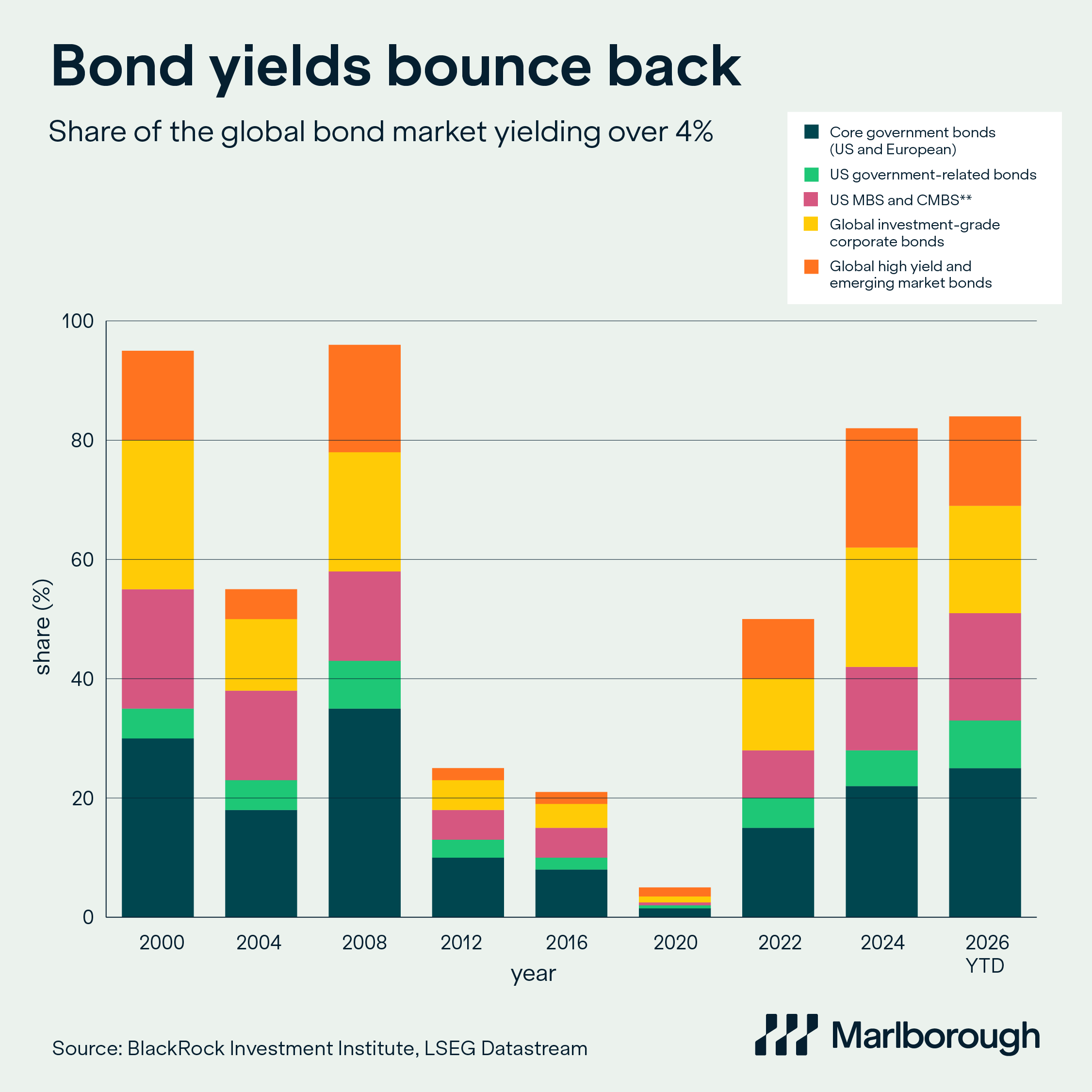
**Mortgage-backed securities and commercial mortgage-backed securities. These are bonds backed by pools of property loans. Investors receive their income from the mortgage repayments.
Higher starting yields don’t remove risk, but they give investors more income and potentially a greater cushion against market volatility. They also give portfolio managers a much broader toolkit for building diversified portfolios.
We believe that today’s higher yields have made bonds more compelling, although we’d also emphasise the growing importance of a selective approach and careful portfolio construction.
So, while markets may look at higher yields and see a problem, portfolio managers can also see an opportunity. More income and more choice are now on offer, and that should mean more potential for diversification.
Four hundred years after that Dutch bond was issued, the principle hasn’t changed. Capital has a price, and today investors are finally being paid more of an income for that capital again.
Higher yields may be uncomfortable for borrowers, but for investors they’ve helped put the ‘income’ more meaningfully back into ‘fixed income’. And that’s important because it’s offering the potential for greater diversification in portfolios.
Don’t forget to check out the rest of this week’s multi-asset updates below.
This article is provided for general information purposes only and should not be construed as personal financial advice to invest in any fund or product. These are the investment manager’s views at the time of writing and should not be construed as investment advice. The opinions expressed are correct at time of writing and may be subject to change. Capital is at risk. The value and income from investments can go down as well as up and are not guaranteed. An investor may get back significantly less than they invest. Past performance is not a reliable indicator of current or future performance and should not be the sole factor considered when selecting funds.

