
View
Multi-Asset


Capital is at risk. The value and income from investments can go down as well as up and are not guaranteed. An investor may get back significantly less than they invest. Past performance is not a reliable indicator of current or future performance and should not be the sole factor considered when selecting funds.
By selecting intermediary or institutional investor I confirm that I am a financial professional and understand that the information should not be distributed to or relied upon by any other persons. It’s provided for general information purposes only and is not personal advice to anyone to invest in any fund or product. Information taken from trade and other sources is believed to be reliable, although we don’t represent this as accurate or complete and it shouldn’t be relied upon as such.


An Uber ride to the airport recently reminded me that impressive technology doesn’t always make for a comfortable journey.
The electric car was quiet and quick. Unfortunately, the driver seemed determined to demonstrate its rapid acceleration at every opportunity. Pulling away from the lights, zipping into every gap, and then stamping hard on the brakes. Sitting in the back, my stomach was considerably less enthusiastic about the whole thing.
Artificial intelligence (AI) is giving investors a similar experience.
The technology is impressive. But the pace of change, and the sudden shifts in expectations, can leave markets feeling rather queasy.
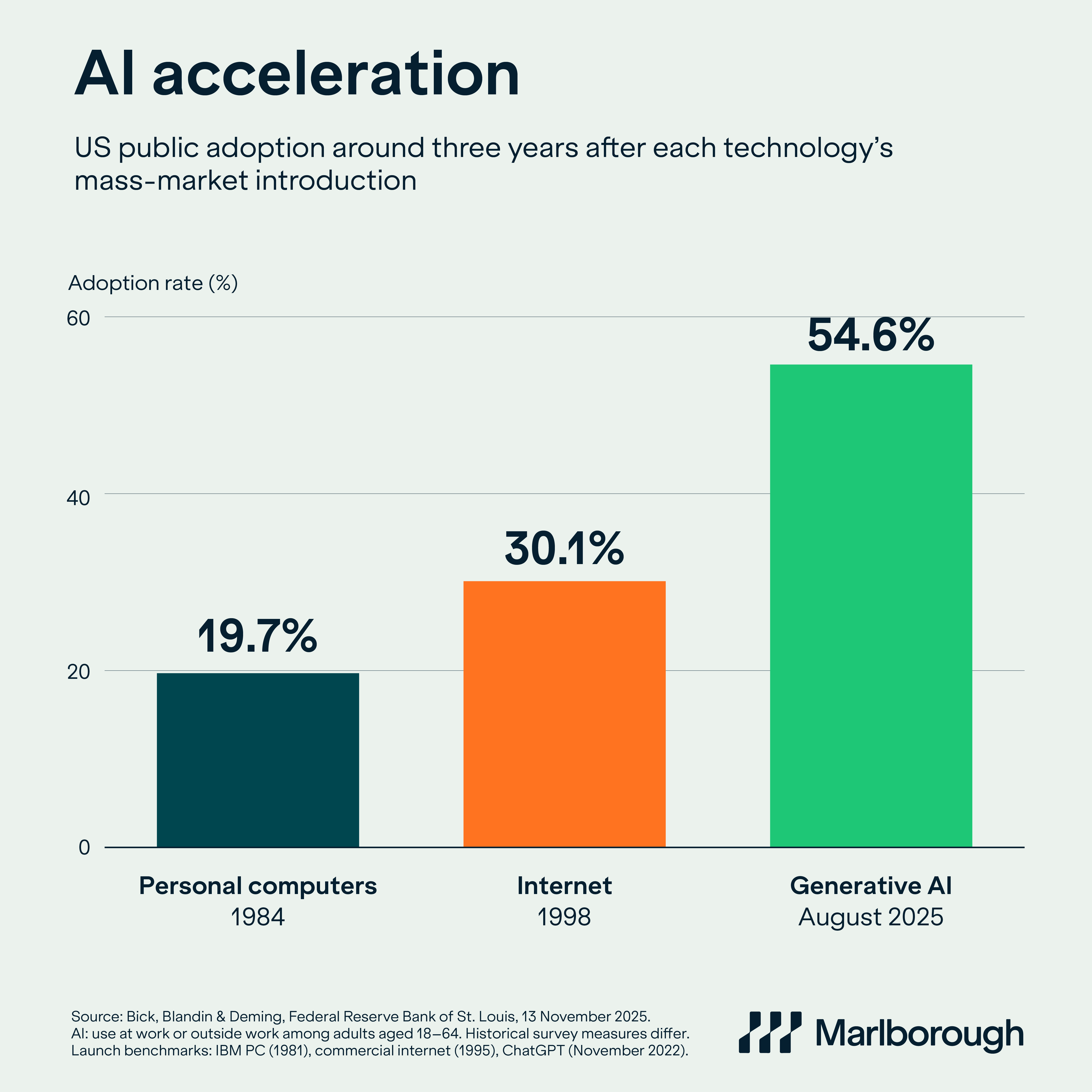
This week’s chart helps to illustrate why it feels like AI is changing our world so quickly. Research from the Federal Reserve Bank of St Louis in the US compares adoption rates roughly three years after the mass-market introduction of three technologies: generative AI*, the internet and personal computers.
It shows that just under three years after the public launch of ChatGPT, almost 55% of US adults aged 18-64 were using generative AI. By contrast, only around 20% of adults were using personal computers at a similar stage, and for the internet the figure was around 30%.
*Generative AI is technology that creates new content. It includes chatbots such as ChatGPT and Microsoft Copilot, which can write text to answer questions, as well as tools that create images or video.
Why are so many people embracing AI so quickly? It’s travelling along roads already built: our phones, computers and the internet. Many AI tools are inexpensive and straightforward to try. There’s no need to buy a new machine or learn to code before getting started.
For investors, that speed creates uncertainty about the companies that will benefit and those whose business models will come under pressure. The ‘SaaSpocalypse’ sell-off of software stocks earlier this year was driven by concerns that AI could undermine ‘software as a service’ (SaaS) businesses. It showed how stock markets can begin to reprice a threat long before its effect on earnings becomes clear.
Meanwhile, leading AI labs have themselves called for stronger safeguards and a slower pace of development.
Little wonder the conversation swings between abundance and apocalypse. Our expectation is an uneven journey: meaningful benefits alongside disruption, adaptation and occasional disappointment.
Which brings me back to the Uber.
One way to ease motion sickness is to put down the phone and look towards the distant horizon. Focusing on something stable can help when rapid acceleration and sudden stops are unsettling your stomach.
That’s a useful lesson for investors. Look past the daily headlines, and AI has substantial potential to improve productivity, accelerate discovery and create new opportunities. But these benefits will take time to develop – and won’t be shared equally.
Keep an eye on the horizon. Rapid adoption doesn’t guarantee attractive investment returns: earnings, competition and the price paid for a stock still matter. A disciplined, diversified portfolio can help investors participate in AI’s long-term potential without reacting to every sudden twist and turn involving this new technology.
This article is provided for general information purposes only and should not be construed as personal financial advice to invest in any fund or product. These are the investment manager’s views at the time of writing and should not be construed as investment advice. The opinions expressed are correct at time of writing and may be subject to change. Capital is at risk. The value and income from investments can go down as well as up and are not guaranteed. An investor may get back significantly less than they invest. Past performance is not a reliable indicator of current or future performance and should not be the sole factor considered when selecting funds.

