
View
Multi-Asset


Capital is at risk. The value and income from investments can go down as well as up and are not guaranteed. An investor may get back significantly less than they invest. Past performance is not a reliable indicator of current or future performance and should not be the sole factor considered when selecting funds.
By selecting intermediary or institutional investor I confirm that I am a financial professional and understand that the information should not be distributed to or relied upon by any other persons. It’s provided for general information purposes only and is not personal advice to anyone to invest in any fund or product. Information taken from trade and other sources is believed to be reliable, although we don’t represent this as accurate or complete and it shouldn’t be relied upon as such.


Investors have been given a sharp reminder that markets don’t move upwards in a straight line.
US stock markets fell heavily last week, led by many of the technology companies that had previously benefited most from enthusiasm around artificial intelligence (AI).
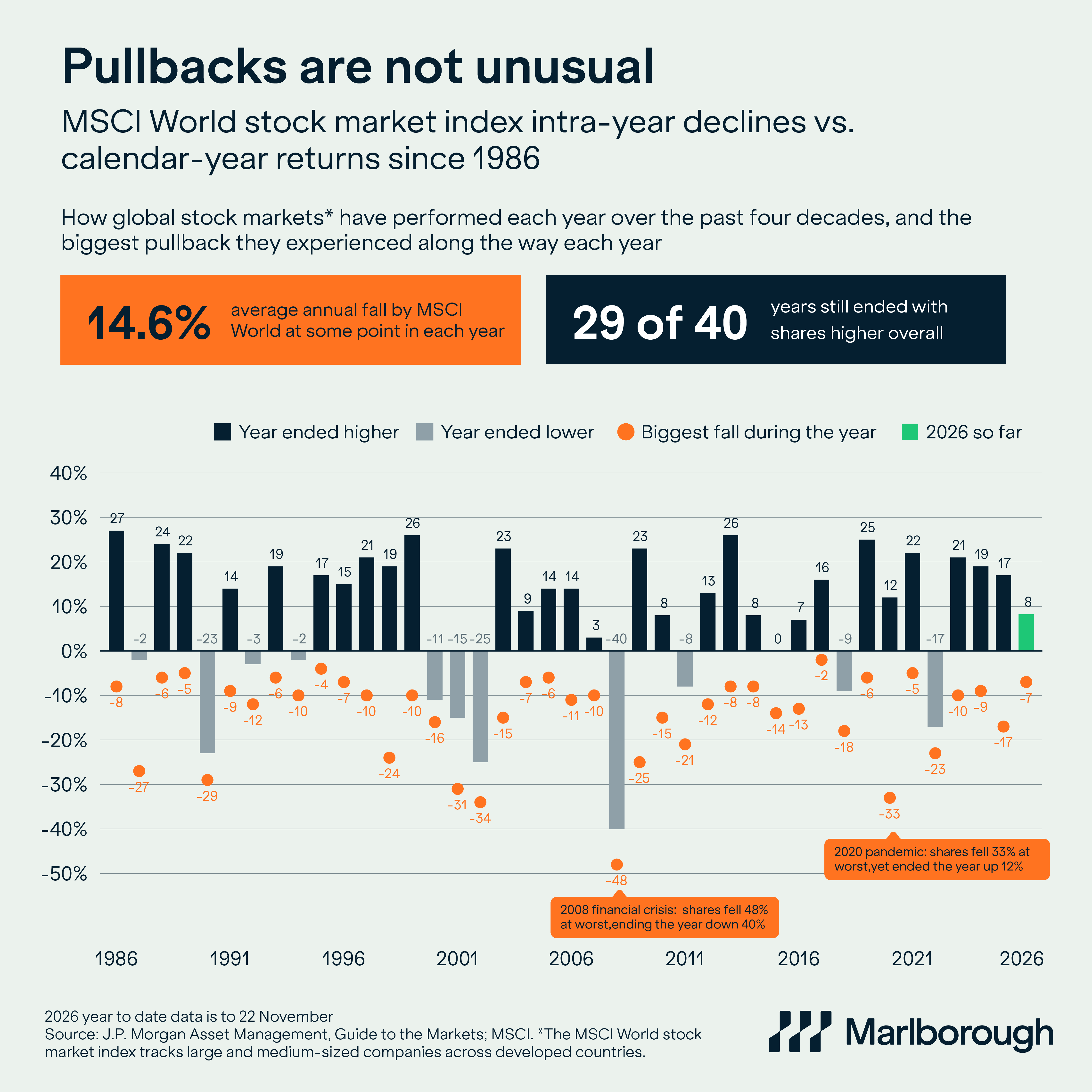
During periods of market turbulence, it’s often helpful to take a step back and put events in wider perspective. As our chart shows, stock market moves like this aren’t unusual. Pullbacks of between 5% and 15% are regular events.
They can be uncomfortable, particularly when they happen quickly, but they don’t automatically signal the beginning of a prolonged downturn in markets.
Over the past 40 years, the MSCI World stock market index has seen an average fall (or ‘intra-year decline’) of 14.6% at some point during each year. Yet annual returns have still been positive in 29 of those 40 years.
There wasn’t one single trigger. Several worries arrived at roughly the same time.
First, investors are concerned about the extraordinary amount of money companies are spending on infrastructure to support the growth of AI. This includes heavy investment in chips, data centres and power infrastructure.
Investors are asking two increasingly important questions: how much more will companies need to spend, and when will that investment start producing what markets consider to be sufficient returns?
A change in leadership at chipmaker Nvidia, which has sat at the heart of the AI boom, added to these concerns.
Politics introduced another layer of uncertainty. The Democrats’ sweeping victories in the US midterm elections have increased expectations that the technology sector could face greater political scrutiny and regulation.
In addition, the highly anticipated stock market flotation by Anthropic, which is behind the Claude chatbot and AI model, attracted substantial demand. Investors wanting to participate needed to find the cash, potentially contributing to selling elsewhere in already nervous markets.
AI investment is no longer simply an issue for technology companies. Spending on data centres, chips, energy and associated infrastructure has been making an increasingly important contribution to US economic growth. If companies significantly reduce their investment plans, the effects could spread into the wider economy.
The question, therefore, is whether we are seeing greater discipline around AI investment or the beginning of a much more significant slowdown. At present, we think the former remains more likely, but it’s something we’re watching closely.
There are genuine risks, and market turbulence may persist while investors work through their concerns. But the underlying US economy remains relatively resilient, and company earnings have continued to grow.
Another consideration for investors is that stock valuations were looking high in some areas of the market, and this pullback has removed some of that exuberance from share prices.
Pullbacks are uncomfortable, but they’re a normal feature of long-term investing. And different assets don’t necessarily react in the same way. As shares fell last week, government bonds* benefited as investors sought what are perceived as safer assets. This is precisely why diversification across a range of different investment asset classes matters.
For long-term investors, periods like this reinforce the importance of diversification, along with discipline and the ability to keep market moves in perspective.
*Bonds are interest-paying financial products issued by governments, companies and other institutions when they want to borrow money from investors.
This article is provided for general information purposes only and should not be construed as personal financial advice to invest in any fund or product. These are the investment manager’s views at the time of writing and should not be construed as investment advice. The opinions expressed are correct at time of writing and may be subject to change. Capital is at risk. The value and income from investments can go down as well as up and are not guaranteed. An investor may get back significantly less than they invest. Past performance is not a reliable indicator of current or future performance and should not be the sole factor considered when selecting funds.

