
View
Multi-Asset


Capital is at risk. The value and income from investments can go down as well as up and are not guaranteed. An investor may get back significantly less than they invest. Past performance is not a reliable indicator of current or future performance and should not be the sole factor considered when selecting funds.
By selecting intermediary or institutional investor I confirm that I am a financial professional and understand that the information should not be distributed to or relied upon by any other persons. It’s provided for general information purposes only and is not personal advice to anyone to invest in any fund or product. Information taken from trade and other sources is believed to be reliable, although we don’t represent this as accurate or complete and it shouldn’t be relied upon as such.


It’s been a turbulent year so far for stock markets and the situation in the Middle East remains anything but straightforward.
Negotiations between the US and Iran have been stop-start, with progress at times and setbacks at others.
But importantly, dialogue is continuing. And that matters.
Global investors aren’t waiting for a final agreement. They react to the direction of travel. The signal is that both sides are still engaged and, ultimately, looking for a path towards de-escalation.
Markets have responded accordingly. They’ve moved higher and are now sitting just a few percent below all-time highs, despite the ongoing uncertainty around geopolitics, interest rates and the impact of artificial intelligence.
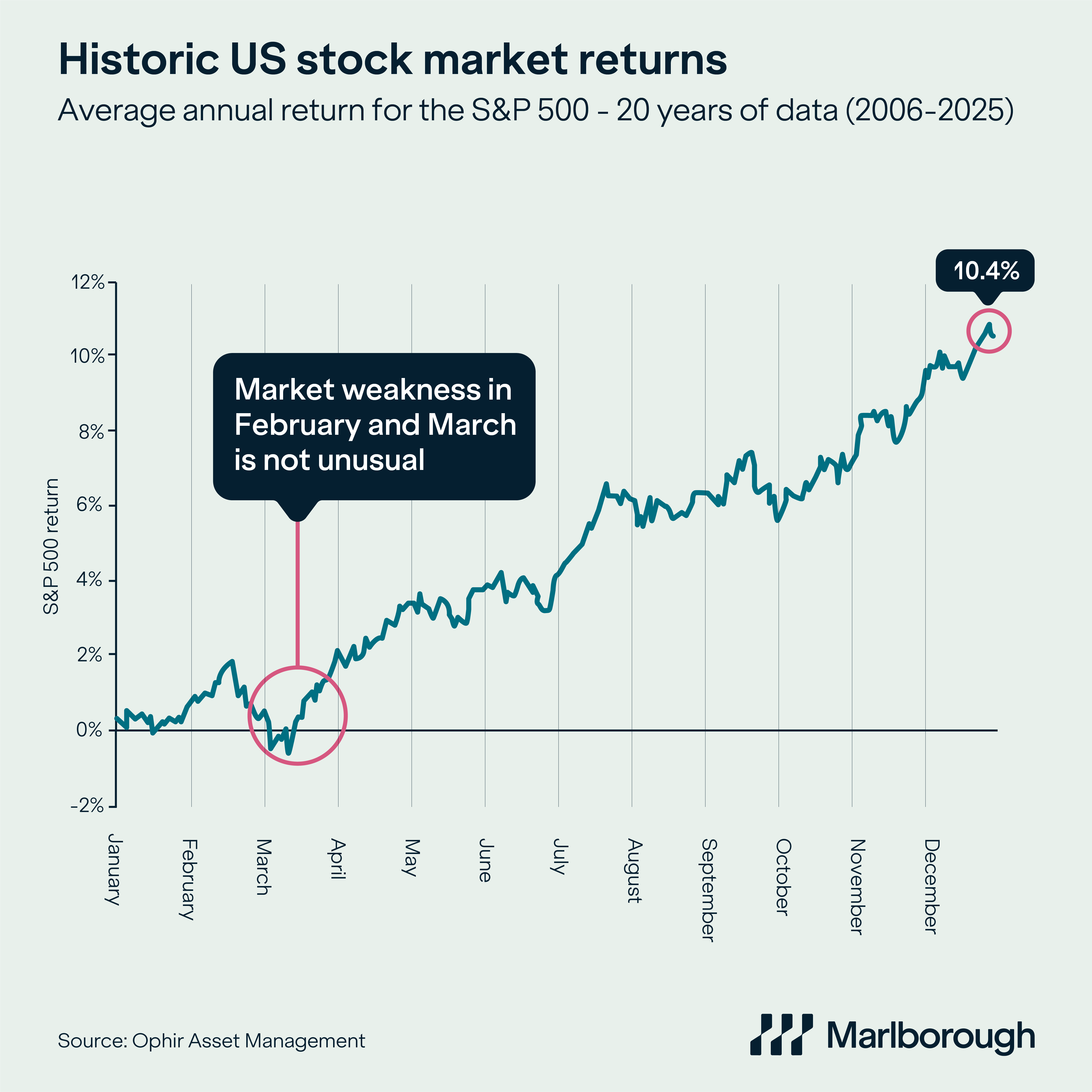
While the situation remains highly unpredictable, our chart this week shows that historically, investors staying the course through the beginning of the year have tended to be rewarded.
While the drivers of recent volatility have been unique to 2026, it’s not unusual for the early part of the year to prove choppy for the US S&P 500 index, with a weak patch through February and March. This period often coincides with ‘earnings season’ when US companies update the market on performance and, in many cases, seek to reset expectations.
What is interesting is what tends to follow. Historically, markets have tended to stabilise and then build momentum into the summer months. This suggests that if the US and Iran can find a formula for a durable peace, then, if history is any guide, markets could continue to push upwards from here.
As our chart shows, over the 20 years from 2006 to 2025, the average annual return for the S&P 500 was 10.4%, according to research by Australian asset manager Ophir.
This is where investing can be difficult. It rarely feels comfortable at the turning point.
Markets are forward-looking. They respond to changes in direction rather than reacting to today’s headlines. But step back and the broader lesson is simple.
Markets are often cyclical. They move through periods of weakness, consolidation and renewal.
The opportunity often emerges before confidence returns. So, the real challenge is behavioural. We are wired to react, particularly when the news flow is constant and often negative. Even experienced investors feel that pressure.
The instinct to act can be strong, but it’s rarely what drives long-term returns. A clear philosophy and a disciplined process matter far more.
This is why, for many investors, having someone else manage their money can be valuable. It creates distance from the noise, reduces emotional decision-making and allows a structured process to guide outcomes.
Markets don’t need certainty. They need a sense of direction. Once that direction becomes clearer, they tend to move quickly. The challenge is not predicting the turn – but staying invested and benefiting from it.
This article is provided for general information purposes only and should not be construed as personal financial advice to invest in any fund or product. These are the investment manager’s views at the time of writing and should not be construed as investment advice. The opinions expressed are correct at time of writing and may be subject to change. Capital is at risk. The value and income from investments can go down as well as up and are not guaranteed. An investor may get back significantly less than they invest. Past performance is not a reliable indicator of current or future performance and should not be the sole factor considered when selecting funds.

