
View
Multi-Asset


Capital is at risk. The value and income from investments can go down as well as up and are not guaranteed. An investor may get back significantly less than they invest. Past performance is not a reliable indicator of current or future performance and should not be the sole factor considered when selecting funds.
By selecting intermediary or institutional investor I confirm that I am a financial professional and understand that the information should not be distributed to or relied upon by any other persons. It’s provided for general information purposes only and is not personal advice to anyone to invest in any fund or product. Information taken from trade and other sources is believed to be reliable, although we don’t represent this as accurate or complete and it shouldn’t be relied upon as such.


Spending time at the allotment over the summer provided an unexpected lesson in investing.
It's been fascinating to see which crops have adapted best to the hot weather. While some have struggled, others have flourished. Chillies, peppers and even watermelons have thrived in the Mediterranean temperatures.
The lesson is simple: when the environment changes, you need to adapt. And investing is no different.
One of the biggest stories for investors recently has been rising government bond yields. These are effectively the interest rate investors receive for lending money to governments. Much like savings rates, they are heavily influenced by the interest rates set by central banks. As markets have become more confident that interest rates could remain higher for longer, government bond yields have risen significantly.
Many investors assume that higher yields automatically mean inflation expectations are rising. However, this week's chart shows this isn't the case. The reality is that while US government bond yields have risen sharply, this is largely due to an increase in the ‘real yield’, the return investors receive after inflation has been taken into account.
Our chart shows the yield on 10-year Treasuries, which are US government bonds with 10 years until ‘maturity’, when the money borrowed is due to be paid back to investors.
This year that yield has climbed to around 5.1% (at the time of writing). Within this yield, the part that reflects bond investors’ inflation expectations – known as the ‘inflation breakeven’ – has remained relatively stable. It’s currently around 2.4%.
Meanwhile, the real yield has increased significantly. It’s currently around 2.7%. In effect, bond investors are demanding a higher real return to lend to the US government. And the same is true for many other governments.
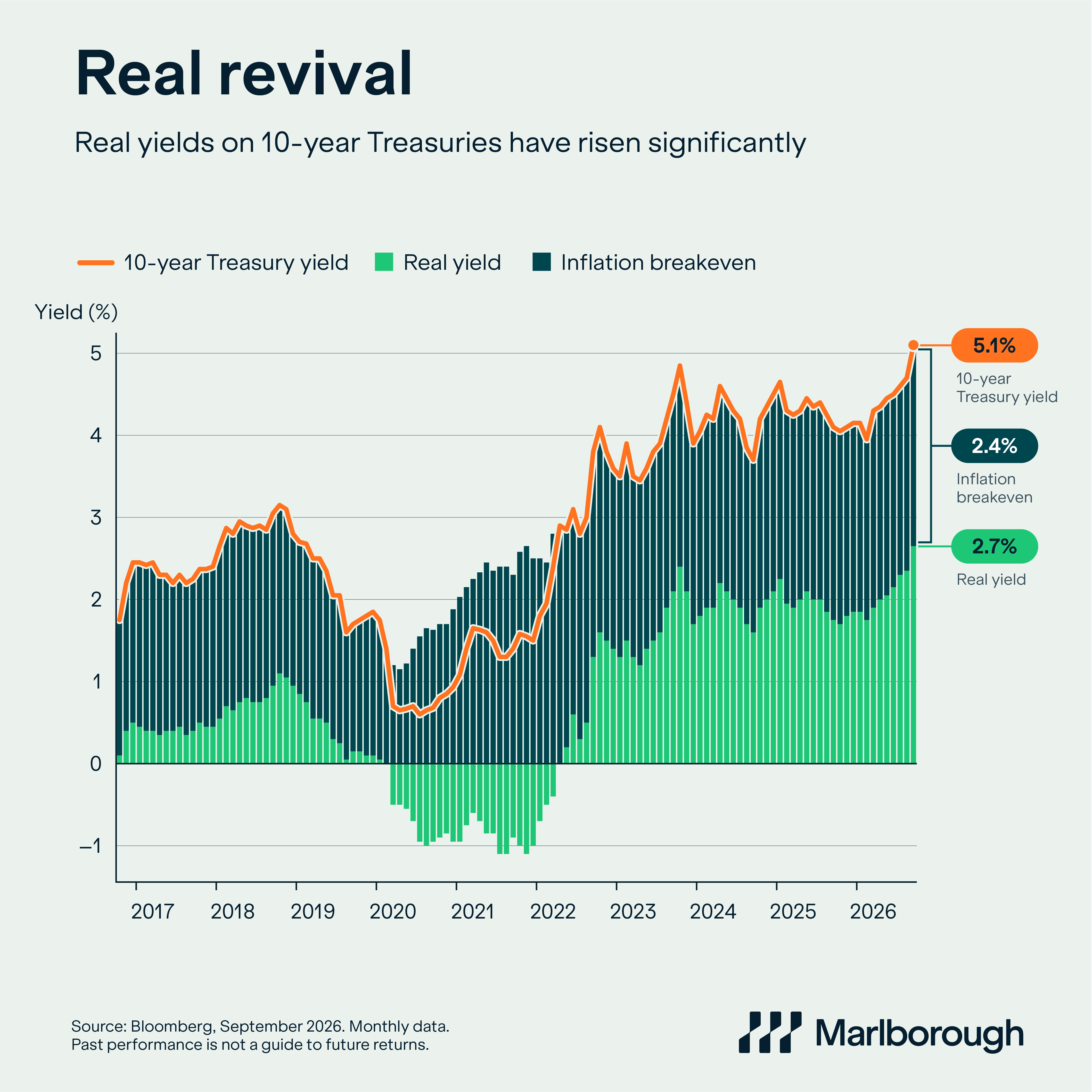
Back in 2020 and 2021, real yields were negative. Bonds paid some income, but not enough to keep pace with the market’s forecasts for inflation, so investors could expect their purchasing power to be eroded over time. Interest rates were very low, so borrowing was cheap and investors often had little choice but to take more risk in pursuit of returns. Today, the picture looks very different.
The US economy has proved more resilient than many expected, recession fears have faded and markets increasingly believe interest rates could remain higher for longer. This has pushed up real yields, while bond investors’ inflation expectations have held steady. As a result, US government bonds are now offering the potential for meaningful above-inflation returns.
For years, one of the main criticisms of government bonds was that they provided little income and offered limited protection against rising prices. That’s changed: real yields have recently reached their highest levels since the Global Financial Crisis.
This matters because these yields influence almost every corner of financial markets, including mortgage rates, company borrowing costs and government financing. They can also have an impact on equity markets.
However, these higher real yields also mean bonds can once again offer something else: genuine income and diversification.
Just as allotment holders adapt what they grow to suit changing weather conditions, investors need to adapt to changes in the market environment.
After years of disappointment, government bonds are once again offering the potential to generate above-inflation returns and play a more meaningful role in diversified portfolios.
This article is provided for general information purposes only and should not be construed as personal financial advice to invest in any fund or product. These are the investment manager’s views at the time of writing and should not be construed as investment advice. The opinions expressed are correct at time of writing and may be subject to change. Capital is at risk. The value and income from investments can go down as well as up and are not guaranteed. An investor may get back significantly less than they invest. Past performance is not a reliable indicator of current or future performance and should not be the sole factor considered when selecting funds.

