
View
Multi-Asset


Capital is at risk. The value and income from investments can go down as well as up and are not guaranteed. An investor may get back significantly less than they invest. Past performance is not a reliable indicator of current or future performance and should not be the sole factor considered when selecting funds.
By selecting intermediary or institutional investor I confirm that I am a financial professional and understand that the information should not be distributed to or relied upon by any other persons. It’s provided for general information purposes only and is not personal advice to anyone to invest in any fund or product. Information taken from trade and other sources is believed to be reliable, although we don’t represent this as accurate or complete and it shouldn’t be relied upon as such.


The Premier League season is underway and millions of Fantasy Premier League (FPL) managers are once again agonising over team selection.
Should you spend a significant chunk of your budget on Erling Haaland? Is João Pedro the bargain everyone is talking about? And can you afford to fit both Haaland and Bruno Fernandes into the same team without sacrificing quality elsewhere?
When I first started playing FPL in 2009, success was often a blend of instinct, football knowledge and a little bit of luck. Today, the amount of information available to managers is extraordinary: goals, assists, defensive contributions and form. These statistics have transformed the game into something much closer to a data science.
An FPL manager doesn't simply look at how many points a player scored last season. They also consider the player's price, expected role and likely future performance.
The fact that Haaland scored 239 points in the FPL last season is interesting. But the more important question is whether that justifies a £15.5m price tag today.
Investors take exactly the same approach. They don't simply ask how well US equities performed in the past. The more important question is whether at current valuations they still offer the potential for attractive long-term returns.
Of course, building a successful fantasy team isn't simply about buying the highest-scoring striker. Successful fantasy managers understand that every position has a role. Defenders provide stability, midfielders connect the team and goalkeepers offer protection when things go wrong.
Portfolios work in much the same way. Different asset classes and regions can offer different characteristics. Some are designed to drive growth. Others can provide diversification or resilience during periods of market uncertainty. A balanced portfolio, like a balanced football team, is likely to be more effective.
Our chart this week shows how the assets in our portfolios have specific roles like the players on an FPL team sheet.
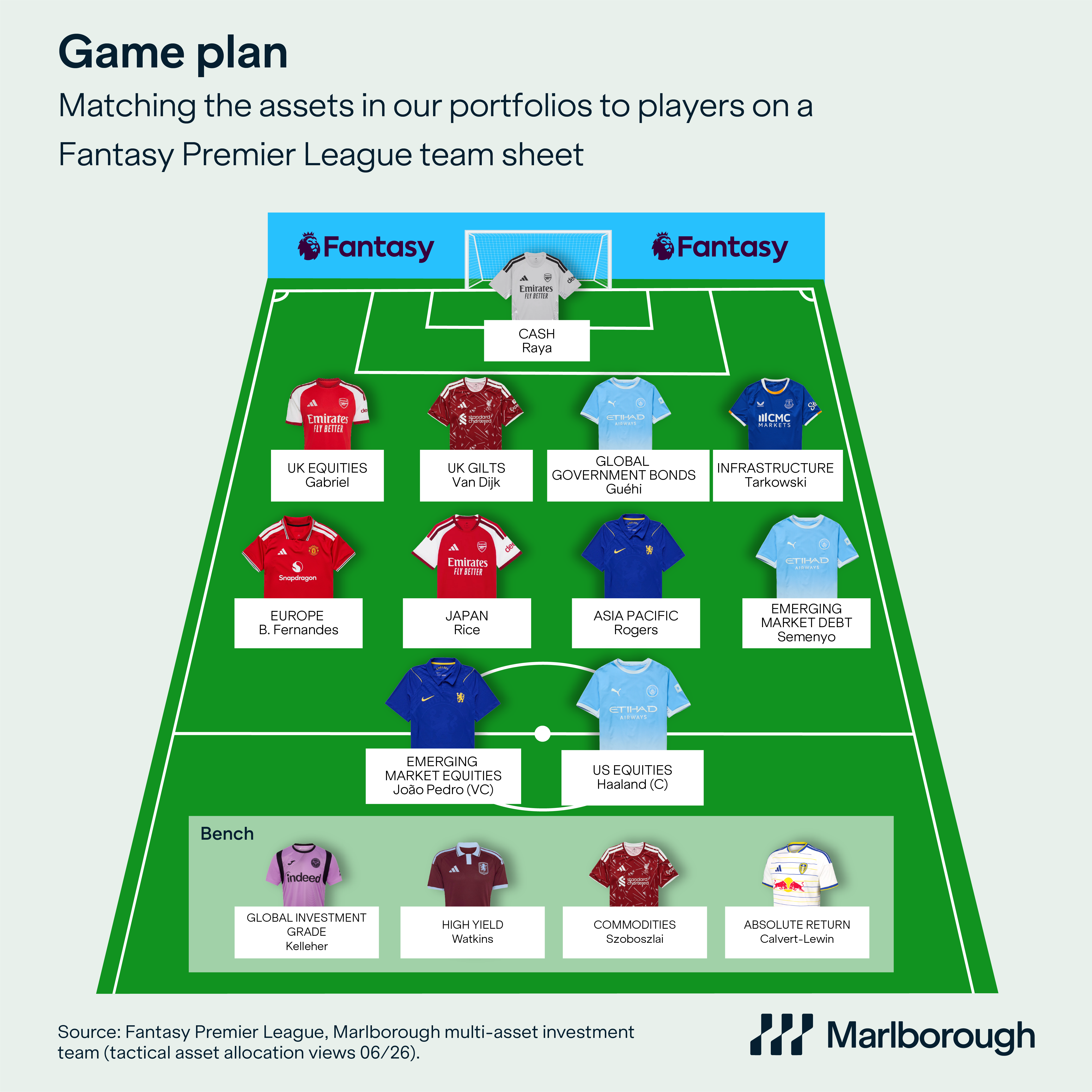
Up front we have US equities (think Haaland). Expensive? Yes. Widely owned? Absolutely. But the track record of US stocks explains why so many managers continue to build their team around them. Also upfront, we have emerging market equities (think João Pedro), where we also see the potential for strong performance.
Meanwhile in midfield we combine European, Japanese and Asia Pacific equities, along with emerging market debt – here the parallels could be with players like Bruno Fernandes, Declan Rice, Morgan Rogers and Antoine Semenyo.
Then, at the back we have assets we view as defensive stalwarts, such as gilts (UK government bonds) and global government bonds. The comparison here could be with star defenders like Virgil van Dijk.
The analogy isn't perfect, but it highlights an important investment lesson: successful investing isn't about finding a single superstar. It's about deciding how to allocate a finite amount of capital across different opportunities, which each have their own strengths, weaknesses and individual role within the broader team.
Just as successful FPL managers don't build teams by chasing last week's points, successful investors shouldn't build portfolios solely around last year's best-performing asset classes. Long-term success often comes from disciplined asset allocation, combining different regions and asset classes to create a portfolio designed to perform across a range of market conditions.
This article is provided for general information purposes only and should not be construed as personal financial advice to invest in any fund or product. These are the investment manager’s views at the time of writing and should not be construed as investment advice. The opinions expressed are correct at time of writing and may be subject to change. Capital is at risk. The value and income from investments can go down as well as up and are not guaranteed. An investor may get back significantly less than they invest. Past performance is not a reliable indicator of current or future performance and should not be the sole factor considered when selecting funds.

