
View
Multi-Asset


Capital is at risk. The value and income from investments can go down as well as up and are not guaranteed. An investor may get back significantly less than they invest. Past performance is not a reliable indicator of current or future performance and should not be the sole factor considered when selecting funds.
By selecting intermediary or institutional investor I confirm that I am a financial professional and understand that the information should not be distributed to or relied upon by any other persons. It’s provided for general information purposes only and is not personal advice to anyone to invest in any fund or product. Information taken from trade and other sources is believed to be reliable, although we don’t represent this as accurate or complete and it shouldn’t be relied upon as such.


When I first started in the City, there was a lunch institution called Fuzzy’s Grub. A full Sunday roast in a sandwich, Yorkshire pudding, peas, gravy, the lot. Queues out the door, especially on a Friday morning.
But Fuzzy’s is no longer with us. Times changed, tastes shifted and new places took over. Something that once felt permanent quietly faded away. And that’s a useful way to look at what markets are grappling with today around artificial intelligence (AI) and jobs.
In simple terms, AI is bringing to office administration what Henry Ford brought to manufacturing. Manufacturing became automated decades ago. Now the same efficiency drive is moving into the office – admin, legal work, coding and customer support. The modern production line is white collar.
Recent developments in AI systems, particularly the shift from chatbots to AI ‘agents’ that can complete tasks end-to-end, have forced investors to rethink many business models.
If one AI system can do the work of several people, ‘per-seat’ software pricing and subscription-heavy models come under pressure. That concern has shown up clearly in share prices, with sharp sell-offs last week across parts of the software and data sector, including London Stock Exchange Group. This was the result of investors reassessing the long-term value of traditional data and analytics franchises.
This week’s chart comes from Goldman Sachs and focuses on which jobs in the US are most exposed to AI automation. It shows various occupations and the percentage of work tasks for each that could potentially be automated following full adoption of AI.
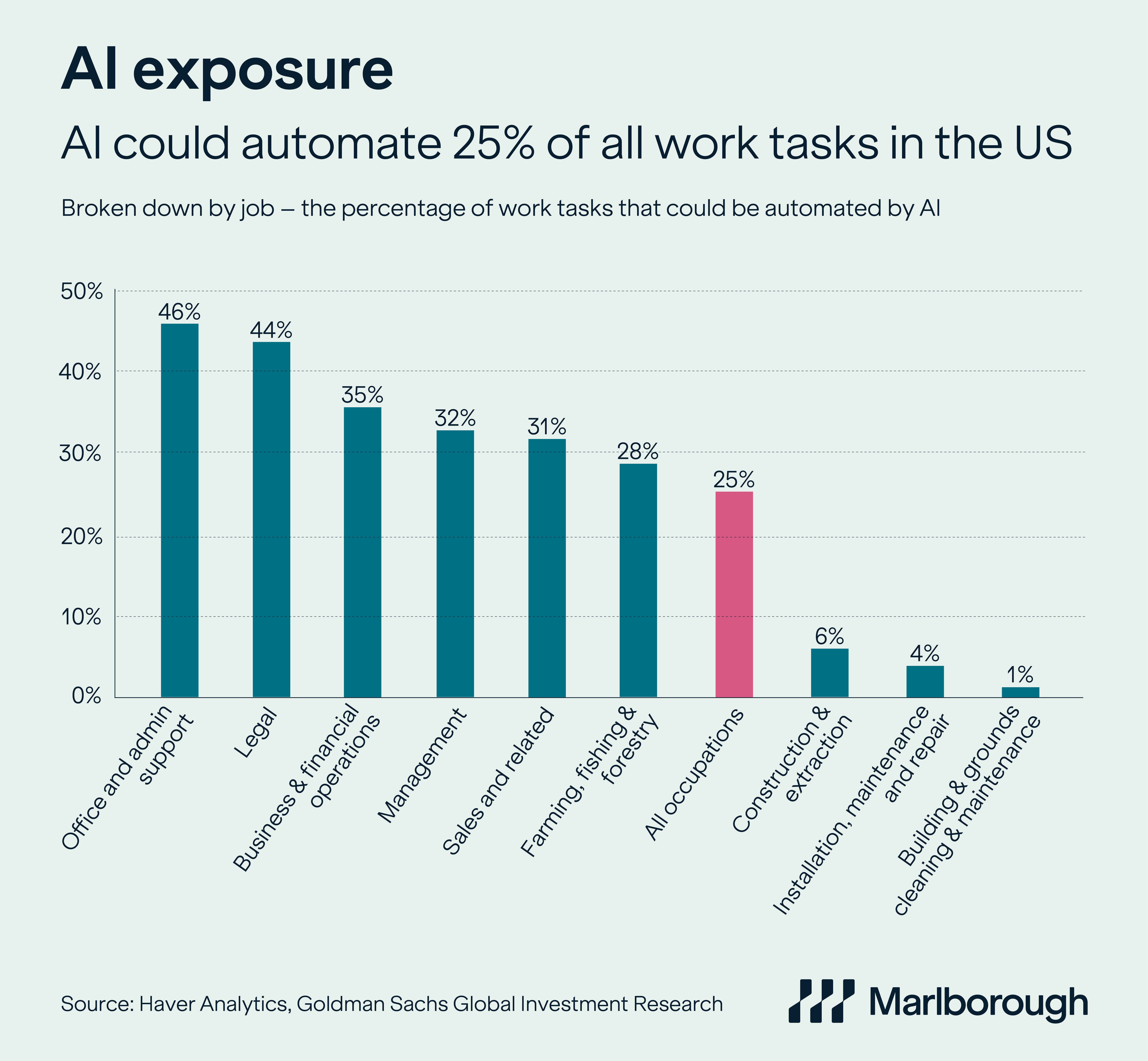
Their conclusion is straightforward. AI could potentially automate around 25% of all work hours. Exposure is highest in administrative, legal and other computer-based roles. Manual and in-person jobs are less exposed, largely because they’re harder to digitise. That’s the source of today’s anxiety: not mass unemployment overnight, but a rapid improvement in efficiency across large parts of office work.
But it’s important to take a longer-term view, because history helps put this into perspective.
Only around 40% of workers today are employed in occupations that existed 85 years ago. Most modern jobs simply didn’t exist in the past. Technology didn’t eliminate work; it changed what work looks like. Over time, new roles emerged, new industries formed and employment shifted rather than vanished. That doesn’t mean the transition is painless. Goldman Sachs expect temporary displacement, with friction as workers retrain and move between roles. But the evidence suggests these effects are transitional, not permanent.
AI is disruptive, but disruption isn’t new. Some roles will fade, some business models will be challenged, and the adjustment may feel uncomfortable. But history strongly suggests that technology reshapes jobs far more often than it destroys them.
The real challenge isn’t whether the economy adapts, it’s how you adapt to the new economy and find your new favourite lunch spot!
This article is provided for general information purposes only and should not be construed as personal financial advice to invest in any fund or product. These are the investment manager’s views at the time of writing and should not be construed as investment advice. The opinions expressed are correct at time of writing and may be subject to change. Capital is at risk. The value and income from investments can go down as well as up and are not guaranteed. An investor may get back significantly less than they invest. Past performance is not a reliable indicator of current or future performance and should not be the sole factor considered when selecting funds.

