
View
The Bond Bulletin


Capital is at risk. The value and income from investments can go down as well as up and are not guaranteed. An investor may get back significantly less than they invest. Past performance is not a reliable indicator of current or future performance and should not be the sole factor considered when selecting funds.
By selecting intermediary or institutional investor I confirm that I am a financial professional and understand that the information should not be distributed to or relied upon by any other persons. It’s provided for general information purposes only and is not personal advice to anyone to invest in any fund or product. Information taken from trade and other sources is believed to be reliable, although we don’t represent this as accurate or complete and it shouldn’t be relied upon as such.


As a rule, when government bond markets are in the mainstream press it is not for positive reasons. Government bonds tend to do well when the economy is doing badly, so for those of us who make a living out of investing in these securities it can feel like a lonely existence. The only time we are cock-a-hoop is when all the other investors around us are in the doldrums.
The flip side is that when the economy is booming, yields tend to rise and bond prices fall. That is painful for us, but at least it is good news for everyone else.
Then there are the other situations, when yields are rising for reasons which are less to do with how great the economy is, and more to do with different, ‘non-growth’ bad things. These are often bad things that are compounded by the rise in yields. For it is often the case that government bonds have a negative feedback relationship with their drivers. What do I mean by that? Well, I mean that when yields go up (a lot) it increases the reasons to buy bonds. Slower growth, lower inflation, lower equity valuations and more disciplined governments are just a few examples. This is in stark contrast to equities which enjoy positive feedback with their drivers. When equities go up, people/companies feel (are) wealthier and thus they spend and invest more which makes the economy go up which makes equities go up. A virtuous cycle. A virtuous cycle which always goes too far, leading to the familiar “up the escalator, down the elevator” pattern of equity market returns.
The last month has been another period where bonds are in the press, and again for all the bad reasons. I am going to take the time this month to walk through what is going on and, more importantly, what is probably not going on. Because accompanying the recent rise in yields have been a number of narratives which do not stand up well to scrutiny. To simplify the analysis, I will focus on what is happening in the US, but to a significant degree the same applies to the other big developed market government bond markets.
Let us be abundantly clear up front. Fiscal policy is being run, managed and implemented naively, irresponsibly and dangerously across the developed world. Running budget deficits (the amount a government spends each year more than it raises in revenue) that are 4%, 5%, 6% or even 7% (or more!) of GDP, at the end of a long economic cycle* and at full employment is stupid and irresponsible. When the debt stock (the accumulated amount of borrowing of a government – deficit is a flow, debt is a stock) has reached around 100% of GDP, or more, this approach to fiscal policy is even stupider. Everyone behaves like this can go on forever, but it can’t. The question is when and how it comes to a head.
All of this is known. It is known today and it was known yesterday. It was known in January when yields were 50-100 basis points lower. It has been known for a long time. Thus, this is not new information, and this leads us to be sceptical about its role in the recent sell-off. Fortunately, we have a way to check such things. If we compare how government bond yields have changed relative to the yield on interest rate swaps of the same maturity we can get an idea about the perception of the riskiness of lending to that government. The reason for this is that in modern markets these swaps are considered the risk-free asset. They are fully collateralised, meaning they carry little to no risk, except for the interest rate risk at their core (and thus the short-term rates on which they are based are truly “risk-free”). When we do so over the last month, we observe that government bonds have outperformed swaps. In market parlance “swap spreads have widened” (the “swap spread” being the difference between a government bond yield and an interest swap yield of the same maturity). That is exactly the opposite of what one would expect if fiscal fears were in the driving seat.
* I don’t count 2020 as the end of the cycle because it was artificial and governments and central banks neutered any notion of a clearing event and some creative destruction. This means the cyclical clock started back in March 2009 in my assessment.
Scott Bessent has been interfering in the US Treasury market. This is ironic, as he made a fortune as a hedge fund manager betting against governments doing similar, ill-advised things. As US Treasury Secretary he is responsible for selling these bonds to investors. That is harder to do when they perform terribly and yields are always rising (even though higher yields mean higher returns…as I often say – everyone is a hedge fund manager now). The obvious answer would be for the US government to run a smaller deficit. But that is the purview of Congress, and they’ve shown zero inclination to rein in their errant and profligate ways. So instead, he is trying to use the rather dubious cover of “improving liquidity” to buy back bonds which are misbehaving, funded by issuing different bonds. The 'ol' bait ‘n’ switch’. He has been doing this a while. But his recent announcement that he intended to up the ante in this game produced a barrage of public criticism, including from his former mentor and all-round investing legend Stan Druckenmiller.
The thing is, in the period since he increased the amount of long-dated US Treasuries he was buying, those same long-dated Treasuries have handily outperformed Treasuries of shorter maturity. In market parlance, the yield curve has flattened (meaning longer-dated yields fall relative to shorter-dated yields, or, indeed, shorter-dated yields rise relative to longer-dated yields).
This is a tricky one. As always with economic analysis the beauty can be in the eye of the beholder, particularly over short periods of time. It is almost certainly the case that, for now, the US economy continues to move forward. It is equally certain that higher-income and wealthier consumers and artificial intelligence (AI) capital expenditures (we will come back to this) are playing a dominant role in that growth. It is also the case that, even at the best of times, the economic data is not hugely reliable in the very short term. Looking at trends is always preferable. Since COVID the reliability of data has plummeted, for many reasons which I will not go into here, but feel free to reach out if you would like to learn more. Of course, those facts would not necessarily prevent the market reacting, so we need to give this driver due attention. When we do so, the picture is as mixed as the data. However, it is true that in recent weeks the data has tended to surprise positively. Those surprises have included some of the most important and closely followed data points. This includes non-farm payrolls, which blew away lowly consensus expectations when released at the beginning of September. This is a driver even more powerful because the jobs data has been rather soft for most of the last 12 months or more.
Now, we would take issue with the overtly positive interpretation of that recent jobs report. The sectors which added jobs are the same ones which have been strong in prior reports. Very few of them are organic or cyclical, they are areas like local government, education and health. Leisure and hospitality are potentially more indicative of cyclical strength but seasonal adjustments and the impact of the World Cup which was held partly in the US have likely created distortions. Sectors like IT, professional services, manufacturing and construction all looked far less robust, as they have done in prior recent reports. However, it would be foolish to expect the market to spend so much time seeking signal, when the noise is much more pleasant (after all who does not want a stronger economy) so our scepticism is not directly relevant here.
As mentioned above, AI-related capital expenditures are (*insert hyperbolic adjective here*) large. We are talking hundreds of billions of dollars per year, and trillions and trillions of dollars in total over a few short years. That sort of large. And that is large. Most of this investment (will be money wasted…no, I’m only kidding, sort of) emanates from the small group of massive and massively profitable tech giants now known as the Hyperscalers (the market loves a snappy euphemism…. Magnificent Seven is dead, baby, long live the Hyperscalers! Sounds galactic, doesn’t it?). Their insane profitability in recent years resulted in them generating gargantuan piles of cash. This, it must be said, is a symptom of the economic ill-health which is masked by everyone’s focus on the small group of overt winners, while the large group of relative losers gets swept under the rug. AI has proven to be just the opportunity they needed to deploy that cash. But it is now deployed. It is an ex-cash pile. The cash is mort. Thus, their Michael Jackson-esque spending spree must now be funded with capital raised and borrowed. Some of it through equity issuance, but most of it through debt of various kinds. All this debt issuance competes with the US government for capital and that process results in higher yields. The thing about this dynamic is that it is theoretically sound, entirely possible, but difficult to prove.
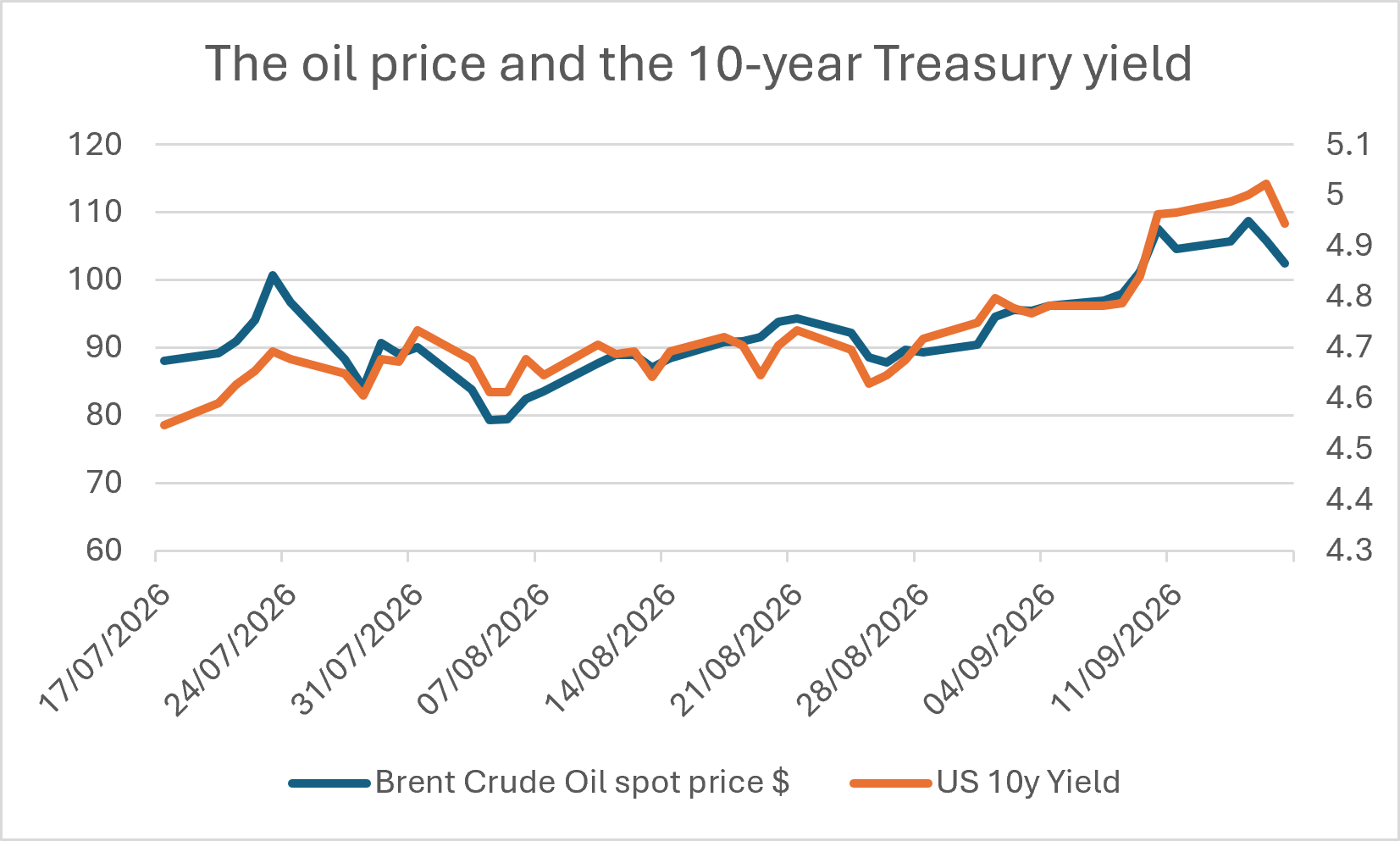
Ding ding ding! We have a winner! This one probably received the least attention among the commentariat. Probably because it is totally outside anyone’s control (the US/Iran conflagration seems beyond any individual party’s control now) and it's less fun to write about. Journalists love to write about cataclysms, and they revel in the joys of criticising politicians they do not like. They have thus been having a field day of late as bond yields have been a huge stick with which to beat President Donald Trump. Justifiably so it must be said. With the obvious proviso that correlation is not causation I simply present the below chart. This is the oil price and the US 10-year Treasury yield. It doesn’t make for a great headline, but it looks to be true. Oil and products which are derived from oil, are going up in price. Thus, inflation is going up. Central banks made complete fools of themselves in the aftermath of COVID, and they do not want to do it again. The fact that the situation could not be any more different does not seem to matter. As they say, give a man a hammer and everything looks like a nail.
Our investment conclusion would thus be far more sanguine than might be expected given the furore. Government bonds have a lot of bad news priced into them. We have no idea when or how the Iran situation resolves positively. However, the fact is that, while the more the oil price rises, the more economic damage is done, it cannot go on rising forever. Equities have a lot of good news priced into them. Central banks are increasingly hiking rates to deal with a problem over which they have little to no control. The things they do exert influence over are already squeaking (job growth and housing being the most pertinent and potent examples). In such an environment, and with a long-term investment horizon, the wise money starts to view these yields as increasingly attractive compensation for an uncertain world in the late stages of a long and dramatic economic cycle.
This article is provided for general information purposes only and should not be construed as personal financial advice to invest in any fund or product. These are the investment manager’s views at the time of writing and should not be construed as investment advice. The opinions expressed are correct at time of writing and may be subject to change. Capital is at risk. The value and income from investments can go down as well as up and are not guaranteed. An investor may get back significantly less than they invest. Past performance is not a reliable indicator of current or future performance and should not be the sole factor considered when selecting funds.


