
View
Multi-Asset


Capital is at risk. The value and income from investments can go down as well as up and are not guaranteed. An investor may get back significantly less than they invest. Past performance is not a reliable indicator of current or future performance and should not be the sole factor considered when selecting funds.
By selecting intermediary or institutional investor I confirm that I am a financial professional and understand that the information should not be distributed to or relied upon by any other persons. It’s provided for general information purposes only and is not personal advice to anyone to invest in any fund or product. Information taken from trade and other sources is believed to be reliable, although we don’t represent this as accurate or complete and it shouldn’t be relied upon as such.


Nearly five years ago, I made what felt like one of my better financial decisions. I fixed my mortgage for five years at 1.41%.
As interest rates subsequently rose, I became increasingly smug about it. The only problem now is that my five years are nearly up. My mortgage comes up for renewal next year and, with the benefit of hindsight, I’m now wishing I’d fixed for 10 years.
But mortgages are quite a useful way of thinking about what’s happening in European bond markets.
Imagine two people walk into the same bank on the same day looking for a mortgage. They want to borrow the same amount and the broader interest-rate and inflation backdrop is the same for both. Yet they don’t necessarily walk out with the same mortgage rate.
The bank will look at each borrower’s finances. What do they earn? How much debt do they already have? How secure are their finances? And, ultimately, how confident is the bank that it will get its money back?
If one borrower looks riskier, the bank will normally charge them a higher rate to compensate for taking that additional risk.
Countries aren’t that different. France and Germany share the same currency and the same central bank, but investors are now demanding substantially more interest to lend to the French government than to the German government.
That’s what this week’s chart shows. The difference between the yields* on French 10-year government bonds** and the equivalent German government bonds recently climbed above 1.40 percentage points.
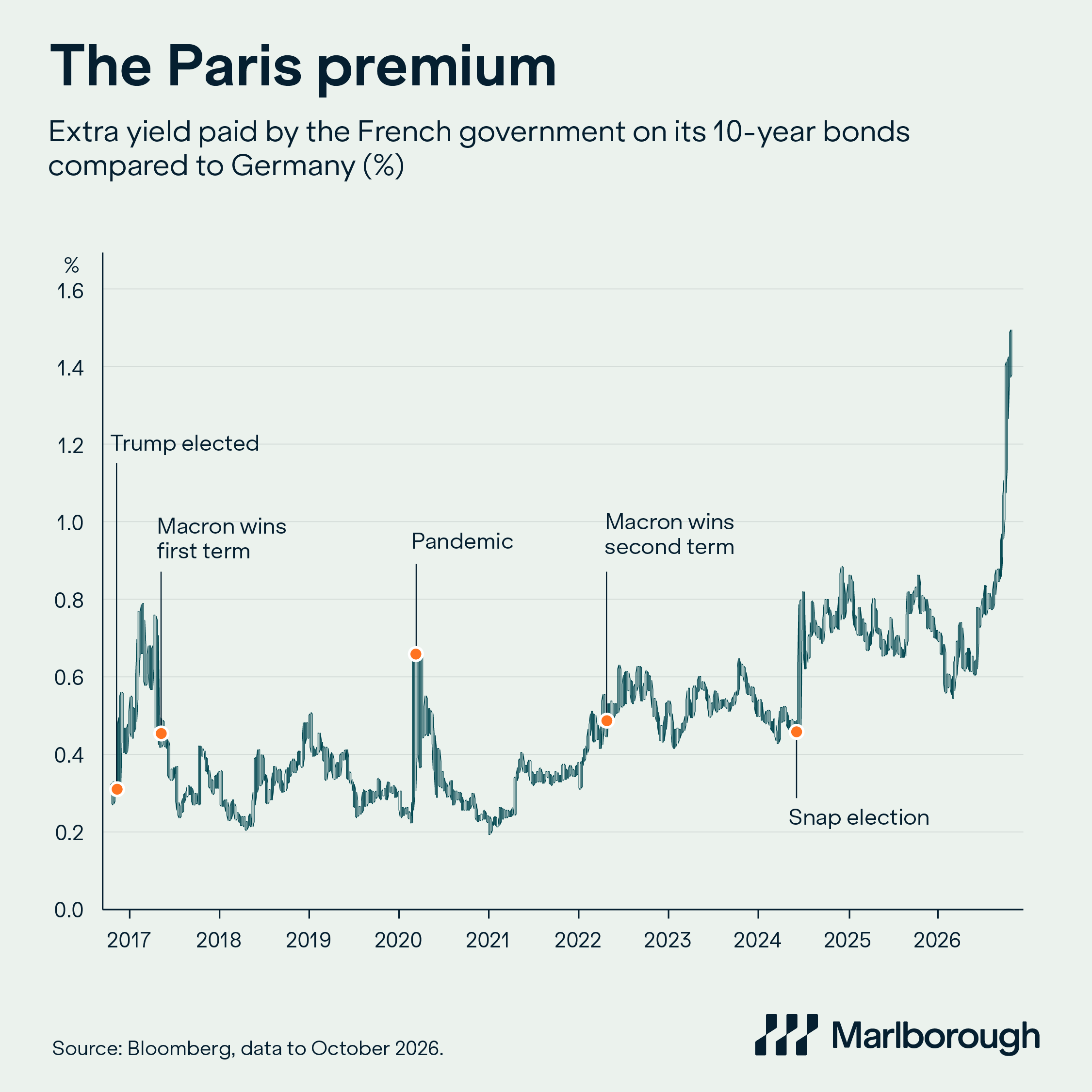
Why are investors charging France more? The country faces a difficult combination of high government debt, a large budget deficit and political uncertainty about how the nation’s finances can be brought under control. In the first quarter of 2026, France’s public debt was almost 120% of gross domestic product (GDP), which is the total value of all the goods and services the country produces in a year.
Meanwhile the government’s deficit – the shortfall between what it raises in taxes and other income and what it spends – is expected to rise to around 5.4% of GDP this year.
Recent political turmoil has understandably added to investors’ concerns. There’s a genuine problem with France’s public finances, and investors are demanding a higher price for taking the extra risk associated with lending to the country.
However, we shouldn’t confuse a repricing of French government debt with a situation like the European sovereign-debt crisis in 2011, when investors were asking fundamental questions about the future of the euro.
The difference is that France has a problem to solve. Europe doesn’t necessarily have a crisis.
And perhaps that’s the most reassuring message from this week’s chart. Markets appear to be doing exactly what we would expect them to do: differentiating between borrowers and charging a higher price where they perceive greater risk.
Perhaps I’ll have a little more sympathy for France’s politicians next year when I have to refinance my own mortgage. I definitely won’t be getting 1.41% again.
France’s rising borrowing costs are a warning, not necessarily a crisis signal. Investors are demanding more compensation because of the increased risks associated with the country’s public finances. But that’s very different from questioning the future of the euro itself.
*Yield is the income paid by bonds or other investments. It’s usually stated as a percentage of the value of the investment.
**A 10-year government bond is one that ‘matures’, which is when the money borrowed from investors is due to be repaid, in around 10 years’ time.
This article is provided for general information purposes only and should not be construed as personal financial advice to invest in any fund or product. These are the investment manager’s views at the time of writing and should not be construed as investment advice. The opinions expressed are correct at time of writing and may be subject to change. Capital is at risk. The value and income from investments can go down as well as up and are not guaranteed. An investor may get back significantly less than they invest. Past performance is not a reliable indicator of current or future performance and should not be the sole factor considered when selecting funds.

